
The End of the World
by Flo Ward
On Tuesday the sun doesn’t set.
We’re sitting outside Scotti’s, Gus holding onto his empty foam-rimmed pint glass, and me still nursing an inch of house white. The light is golden, full bodied, early May, glinting on the glass exterior of the building opposite. The sun makes strands of Gus’s otherwise dark hair amber. I’m swirling the wine around the bottom of my glass without drinking it, because I don’t want the moment to end. I’ve always been like this, pleading one more drink, one more song, five more minutes in bed in the morning when the sheets are heavy and the temperature is exactly right. Gus is always moving forward, always awake and purposeful, while I try to keep things still long enough to be certain I’ve made the most of them. One more kiss before we brush our teeth, one more moment before lights out, please.
Not just yet, I say when he unhooks his coat from the back of the chair. Gus humours me in these situations, says something about how the next moment we have will be just as nice as this one, and I envy his trust in the future. Gus has rainy day savings, performs household chores with enough regularity that he is always pre-empting dirt and untidiness, but lets the dust settle after an argument. I find it hard to believe in what isn’t in front of me, and become anxious after any imperfect interaction. Neither of us predicts what is going to happen, of course.
We don’t realise that the sun hasn’t set, because our news notifications aren’t turned on. Who was the first person to notice, I wonder later, imagining a startled meteorologist, the alarm travelling down an unseen chain to the newsroom, a flurry of text messages sent from journalists to their families and friends, reality spreading outwards like something spilled until it touches us.
When the news does touch us we are still outside Scotti’s, me still making a meal of my wine with tiny, holy sips. Gus leans back on his chair, his eyes closed and a hand on my knee in absent affection. It’s seven minutes late, apparently, someone says at a table near us – the kind of contextless overheard snippet of conversation that wouldn’t have meant anything if it hadn’t coincided with Gus receiving a message with a link to the breaking news article.
So that’s how it begins. It’s curious at first, mainly the sensation of seeing the headline and hearing it being discussed around us at the same time: we’re in the middle of something. I’m reminded of how when the queen died I was sitting in the National Gallery toilet scrolling through the news on my phone, and I heard a gasp over the sound of running water from the woman at the sink outside the cubicle door. I’ve told that story several times since.
A man at the table next to us shows us something on his phone, and Gus bends over to look. Weird, isn’t it, I say to his companion, as if I know her, and she agrees it is. I can hear the man telling Gus that it’s probably the result of some kind of nuclear explosion, that Russia is involved, and Gus is responding with diplomatic sounds of agreement (ever patient), glancing up to catch my eye and grin. I take out my phone and message our group chat, should we all be panicking? with a sunshine emoji, to which someone replies with a series of question marks and someone else writes, lol just looked this up. I feel a bizarre kind of pride at this ambivalence. All these people in a frenzy but not us! Where were we when the world ended? Just having a drink! Just watching Gossip Girl!
Eventually the woman interrupts her friend’s explanation of a global cover-up to say that they need to leave. We each say goodbye, in an awkward way that suggests more kinship than we have with these strangers, and the woman wishes us good luck. I feel uneasy at that, and tell Gus I think they’re both nut jobs when we’re out of earshot.
The city is out of sync. It’s a glistening, glossy light that illuminates everything in a warm yolk-yellow, so that the pavement seems to breathe and the gutter glints with yesterday’s rain and leaves, trodden into sludge. The silver inside of a discarded crisp packet reflects the sun. But it is also strangely busy, people amassing at the entrance of the Tube station as if commuting to or from work, although it’s nearly nine pm. Not everyone moves with a sense of purpose. A woman stands in the middle of the street looking at the sky, a bewildered expression on her face. Elsewhere there is a bag of groceries abandoned. I say, look, we could forage our dinner, but Gus doesn’t find this as amusing as I do.
We decide to walk to Gus’s flat, which neither of us have done from here before (it will take two hours), but the Tube is busy and the light is, at least, very nice. We still haven’t eaten dinner. The excitement of the situation distracts me from being hungry, until we pass a sandwich shop, still open. I say we should go in. We’ve timed this perfectly, actually, Gus notes.
(This is our thing: to keep discussing and affirming our good fortune as if we’ve made canny decisions – good thing we saved that last episode so we could watch it on a rainy Sunday; wise of us to book our flight for the day before rail strikes; smart that we didn’t go to the cinema tonight or we’d be oblivious to all this, stumbling out of the film into the light with our body clocks thrown off.)
The man behind the counter piles a sliced baguette with folded ham and a tangle of rocket and tells us that normally he’d be shut by now, but why not cash in on a few more hours of business? There’s a TV in the corner of the room showing a meteorologist being interviewed about historic freak weather events. The news anchor says it is one of over eleven instances of erratic weather we’ve seen in the last fifteen years, and he interrupts her to say it is unprecedented. I go on Instagram and click through a barrage of stories: infographics on global warming, Russian nuclear attacks, something about crop failure and rising migration, a selfie with the hashtag #eternalgoldenhour.
Do you think we’ll go to work tomorrow? I ask, and this is somehow absurdly funny. Why shouldn’t we? But also, how could we?
When we get to the river we sit on a bench and I call Mum, who swings between hysteria and uncharacteristic resignation about the whole thing. There are only a couple of tins of tomatoes in the cupboard, she says, it will barely last until Thursday lunchtime. Gus reads all the messages he’s received and interrupts my conversation to confirm it’s a global phenomenon, not currently considered dangerous, still unexplained. Mum tells me I should try and get the train home this evening and I tell her that’s an overreaction, and what would I do at home anyway? The sun isn’t going to set any sooner over Reading. I feel a little guilty after hanging up, for being so dismissive. Gus and I sit in silence on the bench and watch a woman engaged in a frantic phone conversation a few steps away from us. I can’t travel with the kids, she is saying. It’s not realistic.
We walked down this stretch of river on one of our early dates two years ago, and Gus told me about the mudlarks who fished jewellery and gold teeth from its banks. That was back when it was common practice to tip corpses into the water, the river full of bodies and their treasure rather than bits of plastic packaging and polystyrene cups. Although of course, Gus said then, there are still plenty of ancient bones in there, and we peered into the river’s depths, awed by the way this great murky vein of history coursed through the city. These kinds of stories are typical of Gus, who loves to know about the histories of innocuous street signs and places where buildings once stood, who told me early on that what thrilled him most about the world was how it was constantly changing. This is our major philosophical difference — I fear the steady march of time — but it didn’t stop me falling in love with him.
Shall we get going? Gus asks eventually, as if we have somewhere to be. We keep the river on our left, heading east, not looking at the map. Gus doesn’t say much. I point things out to him as we walk, trying to draw him back to me when it feels like he’s drifting elsewhere. Look at the surface of the river in the light, at how strangely solid it seems, how gently rippled. Look at that bus, do you think the driver just left it there? Look at those children, it’s gone eleven and they’re running about with their book bags. Look at the colour of the sky, it’s so beautiful.
Gus’s street is quiet and most of the houses have drawn their curtains. We agree it’s eerie, but it takes me a moment to realise that this is because the sound of traffic has lessened, that the steady swoosh is now almost indiscernible. Have people gone to bed, or have they left? Gus takes his house keys out as I step over a pigeon minced into the road.
*****
Shall we have a cup of tea? Gus asks, standing inside the kitchen holding the kettle aloft. Or coffee? Or wine?
Coffee, I say, turning the radio on. We listen to a report from Sydney, where it’s nine am and still dark and people are queueing to get into the airport. I try, and fail, to remember the name of a girl I knew at university who moved to Melbourne. The stovetop coffee pot sputters and bubbles over, coffee dribbling onto the hob with a hiss. Gus shows me an article on his phone: a car has melted in Arizona’s unrelenting midday heat.
We stayed up all night like this once before, sipping tea and putting the world to rights. It wasn’t long after we met, the early stage of a relationship when time spent together is still like throwing a rope and hoping they are there to catch it, when saying we could do this is letting it take your weight and praying that you’re still attached. So you start small with let’s try that new place for a drink and we should see that film, and then I’d like to go travelling one day becomes we should go travelling together and I want to live north of the river becomes we’ll live north of the river and the future comes into focus, sharpened by two wills pointed in the same direction. That’s how it had been last time we sat in this kitchen at four in the morning, giddy on mint tea and talk of the rest of our lives.
Now we drink our coffee in mostly silence, listening to everything unfolding elsewhere, noticing how the light falls over the plants on the windowsill, rich and warm and life-giving. Gus puts his arms around me and I lean back into him, eyes closed, and wonder how long the sun can hold its hot breath on my face.
*Originally published by Uncertain Stories (2025)
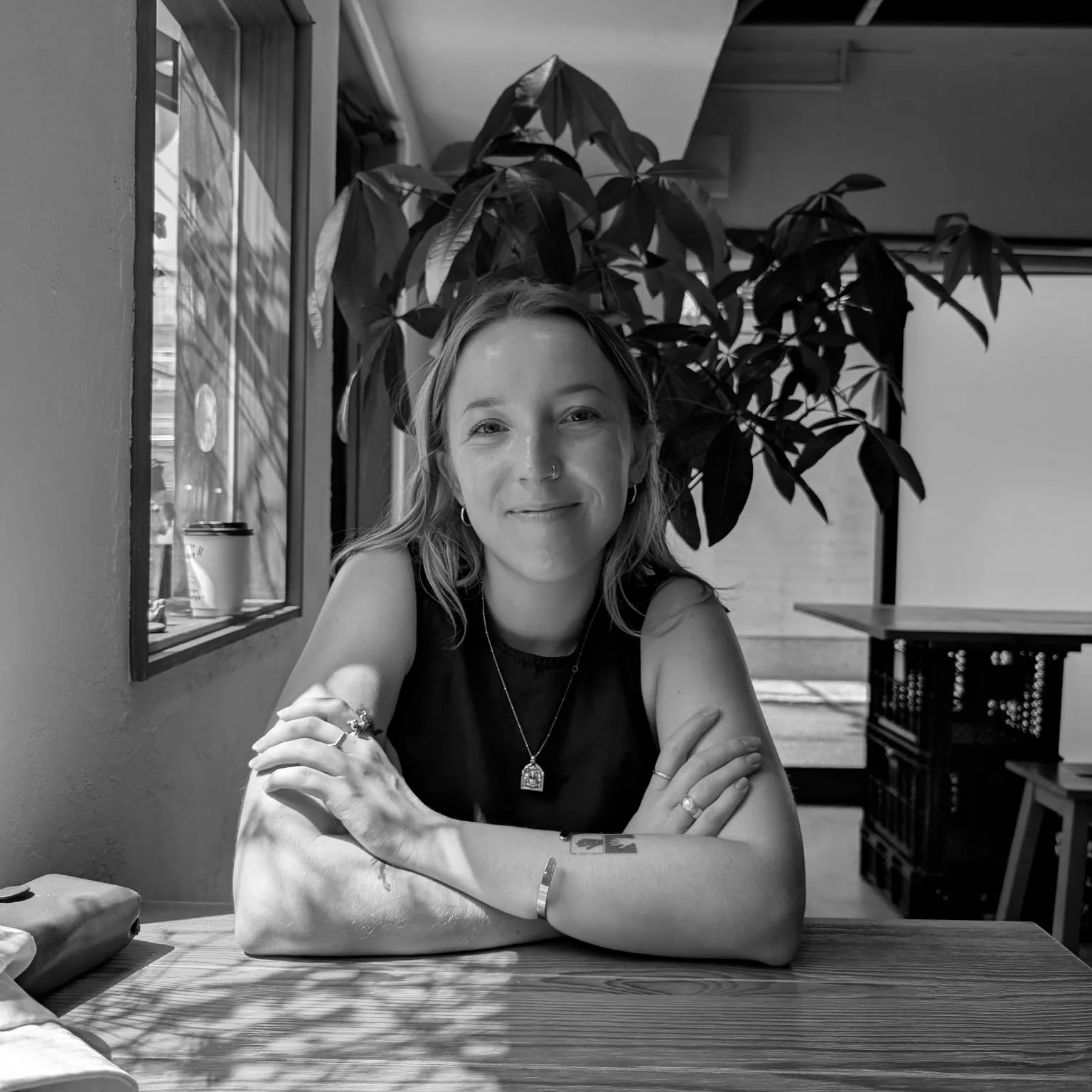
BIO: Flo Ward is a writer from London. Her short fiction has been published by Uncertain Stories, and she is currently working on her first novel.