
Language Barrier
by Joe Baumann
When twenty-one days have passed and Dallas Glory still can’t speak, Esme suggests he should go to the Grief Pit. Her suggestion comes via text—You should go to the Grief Pit?—phrased as a question, even though he knows, and she knows he knows, and he knows she knows he knows, that she is not asking. When he doesn’t respond, she writes, You have to do something. I’ll take you.
Grief, he writes back. From the Old French grever, to burden.
Stop, she writes.
Dallas closes his phone. He might not be able to speak, but he still has words. Language has not left him entirely since his mom died.
*
Aneurysm. From the Greek aneurunein “widen out” to aneurusma “dilation” to the Middle English aneurysm, unchanged from Chaucer to Shakespeare to 2015.
Burst. Middle English bersten, from Old English berstan. The word’s meaning unchanged over time.
Things have always burst, broken. Split apart in ways that they cannot be sewn back together.
*
Esme drives. The Grief Pit is twenty minutes southwest of Innsbrook, so it takes them nearly an hour from the Glory house in St. Louis, where Dallas still lives with his dad, the place sprawling and echoey now that his mom is dead. His four brothers—three older and one younger—all moved out, most of them a long time ago, but Dallas, working as a research assistant for a professor at St. Louis University, can’t really afford his own rent on his meager salary. Staying at home was his mom’s idea; she insisted, coming close to making what might have been the first direct command aimed at Dallas since he was a little kid and had a tendency to not put on his shoes when asked.
To her credit, Esme does not try to fill the car with talk. She plays music, classical, rotating between Chopin and Handel and Vivaldi. She doesn’t like Beethoven or Mozart, calling them “too mainstream,” but Dallas is pretty sure she’s joking when she says this. Esme keeps the windows cracked, and hot air whistles through the car, loud enough that talking would require a certain level of screaming. For all this noise, Dallas is grateful.
When she takes the exit for state route 47 off I-70 at Warrenton, Esme says, “I think this will be good for you.”
Dallas nods, but only barely. She nods, too, bigger, for both of them.
*
Tragic: from the Greek tragos, “goat,” and oide, “song,” literally meaning “goat song,” likely in relation to Dionysian festivals involving the ritual sacrifice of a goat, or a goat awarded as prize for the best play.
Shock: from the French choc for “violent attack” or Old French choquer, “strike against.” Possibly Middle Dutch schokken, “to push, jolt,” and/or Old High German scoc, “jolt, swing.”
Many ways to be shocked. Many forms of tragedy.
*
Dallas has always thought it strange, perhaps foolish, or perhaps lucky, that no one has ever commercialized The Grief Pit. It has no signage, no tollbooth, no gated entrance at which an exorbitant fee is extracted by a landowner or their peon. Instead, a simple turn onto an unmarked dusty road over which Esme’s car humps and hums, then another turn into dense forest, the road nothing more than a pair of beaten-down tire tracks cutting through heavy grass, the route widening to a large patch of dirt that serves as a parking lot.
“Ready?” Esme says when she eases the car to a stop. Then, looking at Dallas, she frowns. “Maybe we didn’t think this through.”
Dallas raises his eyebrows.
“Okay, I. Maybe I didn’t think this through.”
Dallas waves her off, an attempt to convey, It’s fine.
Except it isn’t fine. Well, Esme’s attempt at helping is fine. Everything else, however, is anything but.
*
Undetected: un-, prefix of negation, Old English un- from Proto-Germanic, from Proto-Indo-European n-, “not.” Detectus, Latin “uncover, expose,” and Proto-Indo-European roots un-, “off,” and tegere, “to cover.”
Detection, hiding, seeing, missing: all embedded in language’s most ancient origins.
*
Esme gets out of the car first, turning away from the door to give Dallas a moment. He appreciates this about her, how she always seems to know when to leave him be and when to press. They’ve known each other since college, meeting when first-year English majors were siphoned off into a classroom to get to know the department faculty, who stood in an imposing semi-circle at the front of the room, looking precisely like professors at a small liberal arts university might: lots of thick-rimmed glasses, unkempt hair, scarves, plaid patterns. Ill-fitting khaki pants and weird shoes.
They were, themselves, an odd pair, Dallas with his boring cropped black hair, short stature, and narrow frame, arranged next to Esme with her rainbow-dyed hair—every hue, in order, moving from left side to right—and her height, towering at six-one, one-sixty, numbers she threw out when she introduced herself to Dallas and two others put into a small group to get to know one another, as though these were just as relevant as where she grew up, what her favorite books were, and why she wanted to study English. Instead of answering the last two of these questions, she folded her arms over her chest and said, “I played rugby in high school. With boys. I was good until I tore my ACL. I spent last summer reading Proust instead. He’s okay.”
They took at least one class together every semester, even if it didn’t serve as any more than elective credit for one or both of them; Esme wanted to be a medievalist, so Dallas, the linguistics major, found himself taking courses on Beowulf and Chaucer. Esme, to her credit, didn’t flinch about taking Language and the Mind or History of the English Language (the latter probably more palatable and useful than she let on). Dallas understood that their peers whispered about the two of them—the school was small, about four thousand students, the English major contingent even smaller—hypothesizing that they were a couple, or at least friends with benefits, or something else. He knew they sometimes snickered about them, but any time Dallas brought it up, Esme just shrugged, or slammed shut the book in her lap, looked Dallas in the eye, and said, “Fuck them.”
Dallas hauls himself out of the car. Early August, even early in the morning like this—they left Esme’s apartment at seven-thirty—is humid, the temperature already in the eighties and climbing. The trees around them seem to droop from the heat and sun despite the nourishment of the light; their boughs look as Dallas feels: in a state of perpetual exhaustion, bending under the invisible weight the world is throwing upon them.
But he trudges forward, next to Esme, who takes his hand as they approach the Grief Pit. Her fingers are slick and warm, but unlike the thickness of the sky, this heat he welcomes, soothing and relaxing like the warmth of a hand-made quilt.
*
Flood: from Old English flod, “a flowing of water, tide, a deluge,” via Proto-Germanic floduz, “flowing water, deluge” and Old Frisian flod and Old Norse flod, Middle Dutch vloet. Proto-Indo European pleu- “to flow.”
Floods, floods, everywhere, drowning, drowning, drowned.
*
The Grief Pit is about two hundred yards from the car via a gravel trail buttressed by trees verdant green thanks to the summer sun and recent rain; their branches shimmer and shake. The sound of rustling leaves was always one of his mom’s favorite noises; when she heard it, sitting on the back porch, she would give a little shiver and say, “It sounds like the earth is laughing with joy.”
But Dallas feels no joy as he follows Esme toward the Pit. He works his jaw, tries to will words to his mouth, but when he opens his lips he’s greeted with silence.
It took him a while to realize that he had been struck mute. At first, upon receiving a phone call from his dad that he needed to come home, that “something happened to your mom,” he was able to say, “I’m on my way.” When his brothers arrived one after the other, first Peter, then Michael, then Cal (Nicky, the middle child, lived out of state and was, apparently, unreachable), Dallas was able to sob and speak and murmur his sorrows, just like the rest of them. Even as the first numb days wore on, he had no trouble speaking.
The memorial service changed everything. Not a real funeral, with a full-blown eulogy or service; Dallas’s dad had unearthed a handwritten list of wishes his mom had prepared sometime in the last few years about what to do should she pass away: cremation, please, and maybe a viewing, but nothing more than that. No fanfare. God, definitely none of those blown-up photos of the deceased from a decade ago. “I don’t have the skin for that,” she’d written.
The service was quiet, a line of guests paying their respects in front of a simple silver urn while the Glory family said nothing as they sat in the front row of uncomfortable chairs. Perhaps it was the silence that did it, Dallas doing nothing but watching mourners walk up to the urn, where they would whisper a few words or just bow their heads and move on. All the while Dallas opened and closed his mouth, trying to imagine what he or anyone else could possibly say. Nothing came to mind. Perhaps it was that moment, when he realized language, this thing he had loved all his life, was failing him, that it abandoned him.
He knew the term for this in most circumstances—Broca’s Aphasia—but he also knew that was happening to him was something else: his brain wasn’t damaged; he had not suffered any blunt trauma. He was pretty sure he didn’t have a tumor or infection, as there would be other signs and symptoms. No: this was something wispy and untouchable, a kind of hurt that doesn’t burst blood vessels or tear muscle or crunch bone. A worse hurt, deep and invisible.
No trees ring the edge of the Grief Pit, as though the flora knows to stay away, that something within the large hole in the earth is poisonous. This makes sense to Dallas: all that sorrow has to go somewhere, down at the bottom of that gaping well, and the only place is the soil, porous and inviting, a place where people do not have to reckon with its acidic rot. Dallas expects to smell something, to feel something, like a barrier, a force field, a hand pressing him away, daring him to turn around and go back to the car, but nothing stops him from walking right up to the edge. He stares down into the dark of the Grief Pit and feels dizzy. Dallas nearly cantilevers over, but Esme, with her strong arms, holds him back.
*
Mute: from the late fourteenth century mewet, “not speaking,” from Old French muet, “dumb, mute,” a diminutive of mut, mo, from Latin mutus: “silent, speechless, dumb.”
Render: Latinate re-, “back,” and dare, “give” through Old French rendre to late Middle English “render.”
To be made quiet, to be given silence, speechlessness. A gift?
*
To her credit, Esme makes no demands. She doesn’t prod him to open up, to spill out his sorrow into the Grief Pit. Instead she holds onto Dallas, one hand pressing his lower back, the other perched carefully on his left shoulder like a delicate bird. They stand in front of the Grief Pit for a long time. Dallas tries opening his mouth a few times; he even conjures words in his head, but none of them feel quite right: I miss you, Mom. I love you, Mom. It’s not the same without you, Mom. Thank you, Mom, for everything. And, of course, none of them will emerge from his throat, his vocal flap, his lungs, the connections to his brain numbed to non-function. He tries, instead, to scream, a wolfish howling noise, a guttural, buzzing screech of animal sound, but that won’t come out either. He’s like a faucet with no water source, the tap opened to its greatest width, nothing but echoing air to spit out, silent and meaningless.
He can feel Esme looking at him. Rather than speak, she snatches up his hand; her fingers are huge. She always talks about how proud she is of them, how good they are for the rugby pitch. “I’m kickass,” she likes to say. Dallas always nods and says, “Yes, you are.” But today, all he can do is squeeze her hand, and she squeezes back, his grip tight, hers tighter.
*
Pit: Old English pytt, “natural or man-made depression in ground, water hole, well, grave,” also from Proto-Germanic putt- meaning “pool, puddle,” source of Old Frisian pet, Old Saxon putti, Old Norse pyttr, Middle Dutch putte, Dutch put, Old High German pfuzza.
Many ways to find a hole. Many things to tumble into with no way out.
*
“I really thought this would work,” Esme says. “I really did.”
Dallas nods. Even if he could speak, he’s not sure what he would say. What does it mean for something to work? Dallas pushes down the impulse to look up the etymology; sometimes, language is meaningless. Sometimes, word history doesn’t reveal but instead muddles. Sometimes, no definition helps. Knowing where words like loss and horrible, phrases like terrible pain and gaping, unfillable hole come from does nothing to change the state of things. Sometimes, language is less salve than barrier, pressed up around you, holding all of the bad feelings close.
Esme lets go of Dallas’s hand and sighs, but she keeps looking forward. He realizes that, unlike him, Esme has not been looking down into the Pit but across it, toward the trees on the other side and the blue sky beyond. He wonders if this means she has nothing to cast off, no sorrows worth sending in a downward swirl. Then he thinks: of course she does. We all have our burdens, our sorrows. There is always something that we would love to cast off to lighten our load.
Esme does not share much of herself with him anymore, nothing beyond the day-to-day stuff: work (boring), rugby practice (sweaty, boring), going to trivia nights at bars two nights a week (Tuesdays: fun; Saturdays: sweaty, boring). The deeper stuff, though, Dallas is no longer privy to. He isn’t sure when that happened, and he’s not sure why it’s occurring to him right now. Dallas feels a surge of something dark and tangy in his mouth, a clog of spit and sorrow, tarry and thick: he’s been selfish and stupid, so focused on himself that he’s thought nothing of Esme. He tries to remember anything she’s told him about her own life for the last three weeks and comes up blank.
Dallas turns to her. He wants to tell her he is sorry, but when he opens his mouth, of course nothing comes out.
*
Loss: from Old English los, “ruin, destruction.”
There are other roots, but none of them matter.
*
“I love that you love words,” his mom said to him when he told her he was going to study linguistics. “They can be the most powerful thing, but also the most gentle.”
Dallas and Esme begin the walk back to the car. Nothing around them is any different leaving than it was coming: the sky is still bright blue, nearly cloudless, the breeze is still gentle, just enough to rattle lush branches full of leaves but not to sting their eyes. The temperature is still high. Their path is still empty, not a single other visitor in sight.
“I’m really sorry,” Esme says. He wants to tell her that she can only say it so many times, that each time its meaning, its power, flattens out.
Dallas nods for what feels like the millionth time, but Esme won’t look at him, so he’s sure she doesn’t see it. They’re no longer holding hands.
“I don’t know what I was thinking,” she says.
It pains him to be unable to tell her that it’s okay. But then he wonders if maybe it isn’t okay. Certainly the gnawing hurt of losing his mom hasn’t abided; nothing has been swirled out of him and down into the Grief Pit. What might be going on in Esme’s world that maybe he doesn’t know about, that language cannot convey? We all have canyons and crevices, holes and hideaways where our secrets, our hurts, our wants, all live, tucked away from everyone else.
They reach the car, and Dallas feels sheepish for letting Esme do all of the talking. She looks back toward the Grief Pit, then over the car’s roof, then, staring Dallas in the eye, says, “Sorry,” again. She then ducks inside. Dallas’s stomach curdles like he’s eaten something rancid. He climbs in.
Stuck, he thinks. Stasis. Greek: “a standing still, a standing,” related to statos “placed” and the verbal adjective of histemi, “cause to stand.”
He isn’t sure what to do with this, so he does nothing. Esme finally starts the car and they are blasted with chill air. She looks into the rearview mirror and Dallas looks over his shoulder out the window, wanting to let her know if any cars are coming or she’s getting too close to a tree, but there is nothing he can say to help.
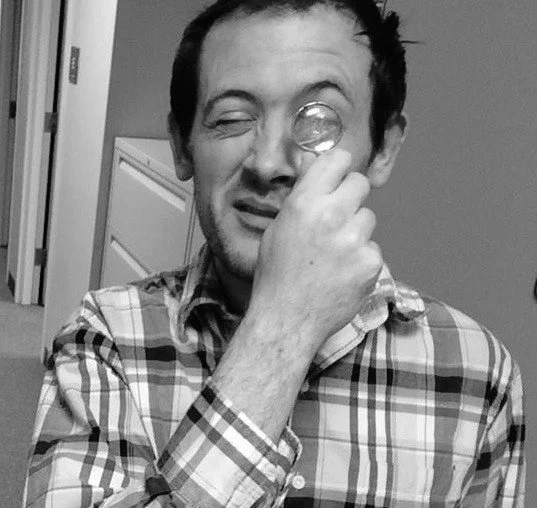
BIO: I am the author of five collections of short fiction, most recently Tell Me from Curbstone/Northwestern University Press, and two novels. My fiction and essays have appeared in Third Coast, Passages North, Phantom Drift, and many others. I possess a PhD in English from the University of Louisiana-Lafayette and was a 2019 Lambda Literary Fellow in Fiction. I can be reached at joebaumann.wordpress.com.