
Oran, City of Stone
by Peter Newall
‘Fuck the French’, said Luc, looking down into his glass of anisette, ‘they should never have come here. And fuck them twice, because once they were here, they should never have left.
‘Since then, everything has gone to shit. Independence, they call it, as if it was something noble, a gift they were giving us, but they couldn’t get us off their hands fast enough, the French, that’s the truth, they just dumped us. And when they left, anyone who was any good at anything claimed their French passport and bolted.
‘Now we’ve got a gang of crooks running the place, lining their pockets and promoting their cousins. Decolonisation, they call it. I would rather salute the two lions sitting outside the bank here than any number of Algerian flags.’
Luc was half drunk, but he said the same things when he was sober. I often worried that his mouth would get him in trouble; it wasn’t wise to speak publicly against independence. Algerian patriotism was compulsory these days. A secret police had been established, very vigilant about anything they regarded as disloyal or seditious. And there were plenty of local youths, emboldened by the things the guys in charge were saying, who were only too happy to beat up anyone they thought wasn’t sufficiently patriotic. The number of men who nowadays claimed to have been in the FLN was astonishing. If they really all had been fighters, the civil war would have been over in six months.
‘What’s the problem, you miss French cuisine?’ I asked Luc, trying to lighten his mood.
‘No, you know I never liked that stuff anyway, I eat kefta and chakhchouka and couscous. Like Mama made.’ Luc had a French father and an Arab mother, who brought him up alone after the father, a sergeant in the Marines, returned to France. ‘I don’t even like cheese,’ he said, grinning. He reached for the packet of cigarettes that lay on the marble topped table.
‘Although I do miss Gauloise, I got used to them, twenty years I smoked Gauloise, and now they cost three times as much, if you can get them at all.’
Luc was a musician, a very good pianist in the orientalist style; he’d learned from Maurice El Médioni. He used to have work every night in the cafes and bars of Oran, but he didn’t play in public any more.
‘I can’t stand it, there’s no point, there’s nobody to play with. As soon as independence arrived, the musicians all left. I mean, I understand why, they were mostly Jews, and no Jew wanted to stay here then, with Ben Balla and all those psychopaths in charge.
‘They’ve all gone to France, or fucking Canada, or some other place. Or else they’re dead.’ He stubbed out his cigarette half-smoked, and finished his glass of anisette in a gulp. ‘I would play again if L’Oranaise were still alive, or Labassi. Or Blond-Blond, there was a guy, crazy, an albino Jew singing tango and chaabi, in our dialect, too; now he’s a waiter in Paris. And of course if Line Monty came back, but no chance of that, she’s in New York with some rich guy. And good luck to her.’
He waved his hand expansively at the café walls, papered in some indeterminate dark colour, with faded photographs of artists who had played there standing out against the background like blotches of mould.
‘You don’t know what it was like, my friend, you were too busy sailing round the world in oil tankers, but Oran was the best city in the world then. Better than Algiers, better than anything in France. Paris my arse. Marseilles, okay, but only because there were a lot of us there. But the real spirit was here, right here in Oran. Even in this café. It used to be run by a guy called Gasparini, but a Frenchman, now it’s a shitty dump, but I still come here hoping one day everything will somehow go back to what it was, by some kind of magic trick, a slip through a double mirror or something.’
Well, who isn’t nostalgic for his youth, especially if you had the kind of youth Luc had. It’s true I was away at sea for long stretches during those years, but I always returned to Oran between voyages; Luc chose to forget that I saw him, and Cherki and Line and the others, perform many times. And we did have fun, what with the music and champagne and hashish and women and all-night parties. It was glamorous, in a provincial way, maybe, but it gave a man everything he could want, Oran back then.
Perhaps that was why, even though Luc was entitled to a French passport on account of his father, he had never claimed it; he saw himself as Oranais, not French, and he chose to stay here when so many left.
There was some justice in Luc’s complaints about what Algeria had become, but I still liked living in Oran; it was relaxed, faintly mysterious, both ugly and beautiful, stuck between the desert and the ocean, and there were no tourists, unlike Morocco, full of hippies. But of course it was easy for me, I had an Argentine passport now, and any time I didn’t like it here I could leave. There’s always work at sea.
Even though he was no longer performing, Luc usually wore his cream double breasted sports coat, which had been his trademark back then. He’d had it on when he arrived tonight. It still looked smart in the semi-darkness of this bar, but in any good light it was shown up as shabby, creased and crumpled, its elbows shiny. I don’t think he wore it in the hope he’d be recognised, but simply as a statement to himself; I’m Luc Ruimi. I’m still Luc Ruimi. Tonight his tie was loosened, his hair long, and he hadn’t shaved for a couple of days.
The night was hot, dusty and dry, like most summer nights in Oran. Palm trees against a Prussian blue sky, with stars playing amongst their fronds. The smell of salt water and oil rising from the harbour. And we were sitting in this café-bar, where they had advertised there would be music, real music, but there wasn’t, just some faker doing a bad job of imitating René Pérez. The bar itself wasn’t much. A scattering of wooden chairs and battered tables, a bar with a row of coloured bottles on a shelf behind it, a curtain over the doorway to the kitchen. A dreary, greasy, grimy place. If you didn’t know it had once been a famous music café, you wouldn’t set foot in it.
I refused Luc’s offer of a cigarette; I’d already smoked too many, and the air in the café was wreathed thick in pale blue. I wanted a beer to clear my head. I was getting a bit weary of Luc’s lamentations, so after collecting my beer I went over to the jukebox. They had Ektebli Chouaya by Line Monty, which I liked, but I knew it would piss Luc off severely if I played it, and would set off another of his standard rants.
‘Records!’ he’d say. ‘Just studio crap, sterile. They don’t capture any of it, the real spirit of that music. You had to be there. Even Line, okay, she made Ya Oumni, everybody bought that record, and it was always on the radio, but really you had to hear her live, in some packed little club, everyone hanging on every syllable.’
Without putting a coin in the jukebox, I returned to our table.
‘Let’s get out of this place,’ I said. ‘I’ve got a headache, and you don’t want to drink any more of that stuff. Let’s walk down to the beach. There’s other bars down there, if you like, but I want to see the ocean.’
Luc waved a hand dismissively. ‘You go, Maurice, enjoy it yourself. I’ll stay here until they close, and then I’ll go home. I’ve got a lot to think about.’
I didn’t consider he was going to get much thinking done with the alcohol he’d already taken on board, and the alcohol he was going to drink if I left him here by himself.
‘No, come on, man, I need some company, walk with me. You can think better out in the street, anyway.’
To my surprise, Luc shrugged, got up heavily from his chair, and fumbled for the jacket hanging on the back of it. I finished off my beer and signalled to the bartender for our bill. It took a minute, as the fellow was on the phone. I paid; it was only two hundred dinars, and I knew Luc was pretty broke. He didn’t notice, or didn’t say anything if he did. He picked up his cigarettes, but finding the packet empty, crumpled it and tossed it on the table.
Outside it was still hot, but the air was better than in the café. We were standing in the middle of the deserted street. Luc slung his cream jacket over his shoulder.
‘OK, you wanted a walk, let’s go. Which way?’
Just then a motorbike came round the corner, on the wrong side of the road. Two young guys were aboard. They didn’t swerve back to the right lane, but kept coming straight at us.
‘Traitor! Jew-lover!’ one of the guys was shouting. I grabbed Luc by the arm and threw myself to one side, trying to drag him with me. I felt a heavy thud, and lost my grip on Luc’s arm. Then I was rolling over on the asphalt, feeling my elbows grate on the hard ground.
I got to my hands and knees, and looked for Luc. My ears were ringing loudly, much too loudly. I must have had a crack on the head, but I couldn’t feel it.
Luc was lying in the middle of the road on his back, one arm thrown above his head. His cream jacket spread out from his hand like a flag he was waving, only flat on the ground.
I staggered over to him. Blood was coming out his nose and mouth, as far as I could tell; quite a lot of blood. Otherwise his body looked quite unharmed. His eyes were open. He didn’t look at me, but over my shoulder. ‘Fuck it,’ he said, and closed his eyes.
I ran back into the café and rang an ambulance, and it came pretty quickly, but Luc didn’t open his eyes again, even while I was sitting beside his hospital bed.
‘Both lungs punctured, spleen ruptured,’ the young Arab doctor told me matter-of-factly. I wished he’d shut up; I didn’t want to imagine Luc’s insides, all mangled. From the outside, he still looked like a whole man, only very, very pale. Just before it got light, he died.
I left the hospital and went back to my apartment. I had to walk, as the buses weren’t running yet. The streets were empty, and a gritty wind was blowing through the pale dawn.
I made coffee, and sat on the small balcony, looking out over the boulevard below. A couple of stray dogs slunk together across the road and round a corner. It was time to find a working passage on a cargo ship. I didn’t want to stay in this city any more, that was certain.
Not just because Luc was dead, and he was the last of my old friends here, but because a town that could kill a musician was no place to live. Oran, city of stone, stony-hearted city, we were born here, we made you what you are, but now you don’t want us any more. Which means you’re not Oran any more. Well, fuck it, as Luc would have said.
I went to his funeral at Sainte-Marie just before I left. I was the only one there besides the priest.
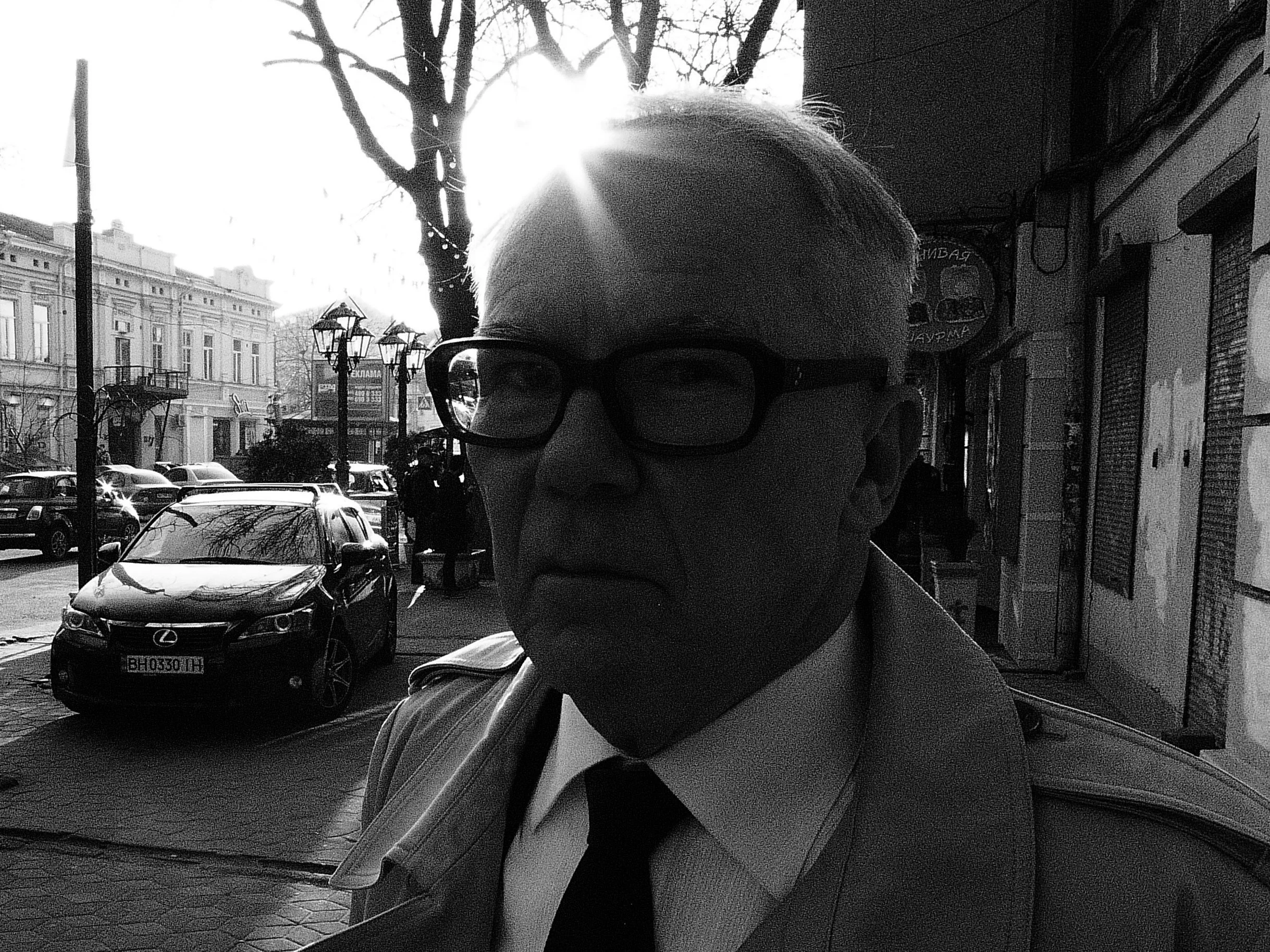
BIO: Peter Newall has worked variously in a naval dockyard, as a lawyer and as a musician. He has lived in Australia, Japan, Germany, and now in Odesa, Ukraine, where he leads a local blues band. He has been published in the UK, Europe, the Americas, Hong Kong and Australia.