
Six Poems
by Akhila Pingali
After hay-making
A stillness steals over treetops like
freeze over a lake and stars over our
guillotine-bound heads. In these parts,
it is in the very soil they say. The roots
drink it in as part of their prescription
and you can see it in the way the leaves
never tremble. You can see it in the breath
lessness of the earth, by which is meant not
the human huff but the absolute death
of all laxity. They say a thousand skulls
rot underfoot and eat through the continuous
aspect until nothing is left of durations,
minting each start as the other face of an end. Once,
in a mass hallucination, a clown on a tightrope fell
and made a show of it, and we slid our bottoms
back up our seats. Let our nails fall from our
mouths. The aftermath exposed, we quit
our currency and drew from chewed-out metaphors a
new temporal dimension. The Making of Xs filled
as many theatres as Xs and more magazines fielded
ekphrastic forms than ever. What did we care
for dropping shoes? The world was unbearably,
wonderfully full of beginnings endlessly
budding, branching into passages of
unrecorded time. We lived each day as if it
was our first and our ancestors’ last. So capacious
were our hearts, the crushing weight of waking
could have black-holed all of us at that circus—
But we are back now among the bottled winds,
creatures of tensile habit, ripping out every calendar
leaf after today: and on the resultant point mass of time
do we still conduct ourselves, these woods,
and the sky that pins them down.
The truth
“The business of the bland sun / Has no affair with me / In my congested cosmos of agony”
—Mina Loy (“Parturition”)
The truth is, I’m struggling. The moon shrugs into a lint-
speckled nightgown and harries the sea, jockeying
sea-hurdles shoreward in a rush of sand and air. I’m
struggling. A girl in a green frock by a curb bends to smell
a periwinkle and rises with a butterfly on her nose. Can
I touch it with my tongue she thinks and then, a crunch. In
the bushes a hungry frog. I’m struggling. On a café table, scores
of white blots on black tied neatly into a square. Scan, materialize.
Above us drops of light nosedive into tepid cups. By some
arrangement. I’m struggling. By some arrangement they coalesce
with song. Plates upon waiters piled to the ceiling. What neighbourly
storms blow over a personalised ill? In bed the stage is set
for a wanting dream. In it an adult in a child’s uniform knows
where to go, what to do, how to be. The adult-child runs
down a corridor mingling with lateral forms revived for this.
Trails a body of laughter behind her. Rattles like the truth.
Elegy for the Undying
“...a chair / overturned in the fenced-in weeds // toward which a misplaced tenderness arises”
—Ari Banias (“Qualm”)
elegies can sing of objects that remain.
pity strung stumbles through senile roads
sulphuric winds holding adrift a bewildered black kite
against a backdrop of embarrassed sky.
you stub a toe apologise to a weepy post
agony endlessly deferred forgets the epicentre
until
all things have eyes and scream.
size-free epithets latch on to objects transferred
you see it in their toy-faces lined up to be shelved
you infer Please sir I want some more glassy-eyed
as a boy with gruel
when you have a thought without a stowing place like a body not sure
of being photographed where do the hands go where the hours
even one dead has an outline a place chalked out
have you heard things cry a machine begging to stop machining
have you drawn them close for warmth
have you fed
gut-wrenched
rice to drainpipes stretched through alienating
distances that run alongside night trains thick with dark
so orphaned you would think the sunlight left with the greens sparing nothing
shuddered for the metal breathing cold
and hungry gathered up your knees for the state of the world.
Vanishing Point
See how much the eye won’t meet. If I draw a straight line
forward from where my toes leave gibbous moons
in the sand, fickle ditches teeming with seafoam
slowly waxing in the recession, and for a moment it’s like
treading air. Like when three shots of vodka throw
an arm around gravity’s suited shoulders and whisk
it away for a word while I tell you that I love you, louder
than usual over tides, crashing. No: if I draw a straight line
starting from the muddy crescent lining my largest toe,
the one that sprouts hair at the joint and you said
it was very manly of me, remember? My hands
made the biggest roosters, or horses, or whatever
it was you Rorschached out of their outline, pinning them
hard against a ruled notebook, the graphite tickling
rough under the softest palms you’d ever touched.
We never spoke of love, not once. Wait, if I draw a line away
from my toes burrowed deep, so deep they confuse
the tiny crabs weaving in and out of their own homes.
I was once on a planetary ring looking down, and their holes
were the same size as our hovels, and there was no
sideways or forwards. Either all faces were glazed
with salt or no ocean had waves. I kicked myself for being
on a planetary ring and still only gazing back at us
but when the Black Death swung by, it was mere seconds
after the Ice Age watered down and that was all I needed to know.
And this of course: if I draw a straight line from this
place where my Indian east-coast town meets the bay,
and it spears ahead over the open water that’s impossible to splice,
gather up, close—
Poem with No Mother
after Alina Stefanescu and Ada Limón
“I… lied to love, lied to its face”
– Alina Stefanescu, “Poem for the Black Bird”
A seething day, I made my mother
wail. It began like rolls of laughter tearing
their way up her gut, for all I could see
on the phone. Sudden abundance. The rain
shrieked in sharp pelts on tin shed and
kiln-hardened brick and I did not sing
to her, black bird that I am. Did not
speak to her again of the motherhood
I did not want, whose shape needs no thought
in some, whose thought birthed in me a hollow
before I laid it to rest. Now when we talk we talk
about her little village by the hills, her little self—
long forested walks to the school, skipping
over humps of roots and hopscotching
across rocky creeks to beat the mud and wet when
some friend yanks a low branch and showers
her in last night’s rain. I picture her, karrasamu
master, banana-leaf shield mid-spin,
cackling when a truant drop lands. How can I
lie to love’s face in this stormy place—
give away the raincoat when I really just
need to keep dry, just a little while longer.
Anamnesis
What memories do you have of a previous life when you’re its very first form?
Space points to critter and says—hey, metalloprotein. Perhaps chlorophyll chugs on through rainforest generations as a former intrepid planet.
Somewhere in the middle, we watch sunsets through the ions of city air. Heme imprints on the sky / blood storms.
I often behave like there’s a gaming console in my head, and a madwoman on it.
In such cases, lives can occur moments apart. It is better not to sit in protest but to observe with interest.
I picture her like this: jockey, brilliant hair, dismounts me. Thins into a crowd so cantankerous it throws up a fog.
Eel City is built around hydrothermal vents. I am that. I come up with friends for food to cool air and return to the spellbinding archaeology of the deep sea-
ted. The rest are invertebrates. What does community mean to them? Why does it mean-
der from your sense of it? Aren’t you looking to be levelled? I implicate myself in this here-
sy, pierce as I do through layers of the elements to get at the meaning of meaning-
lessness. There isn’t always a memo-
rial.
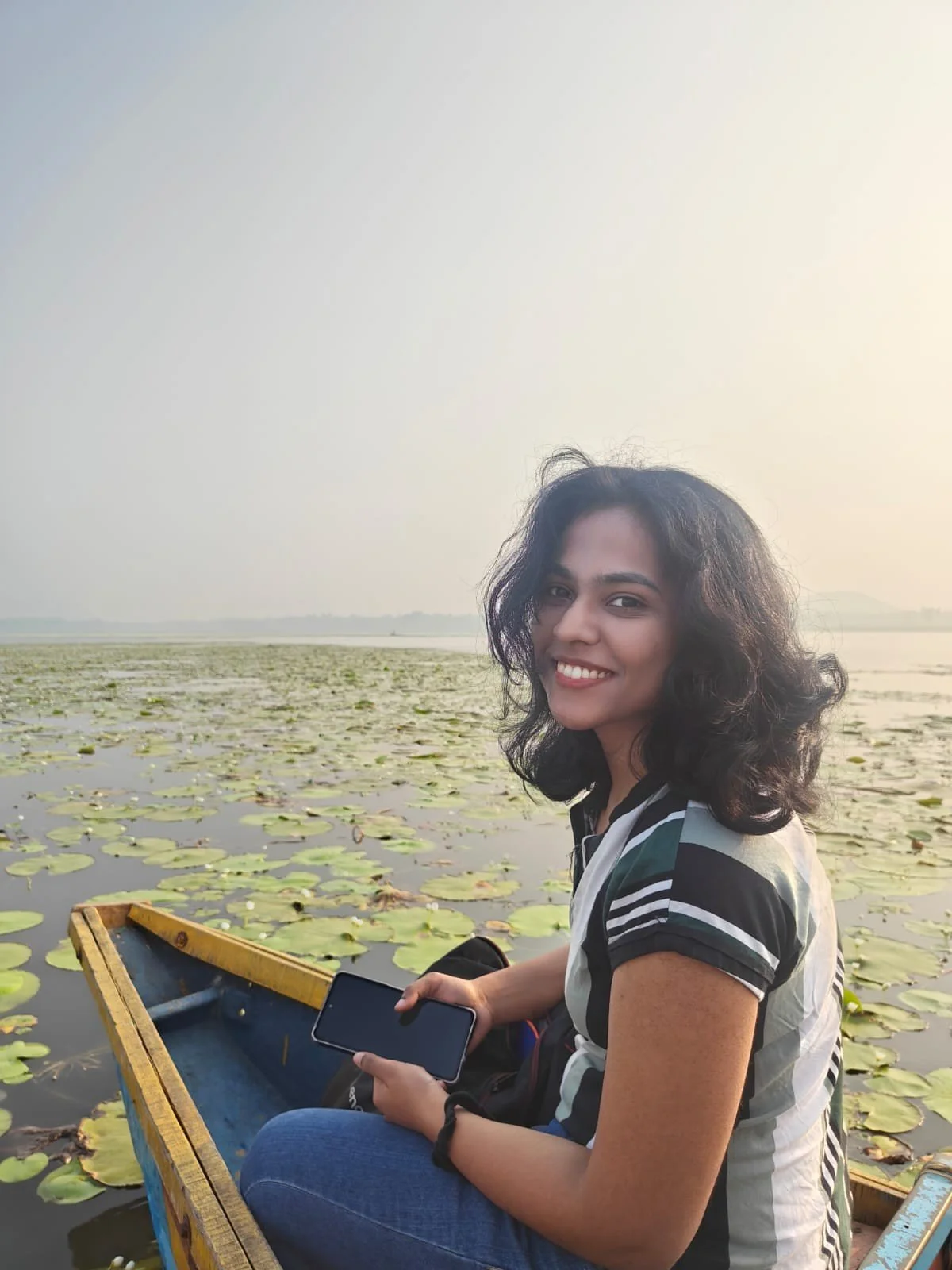
BIO: Akhila Pingali is a research scholar who also teaches Spanish in Hyderabad, India. Her work has appeared or is forthcoming in Frontier Poetry, Midway Journal, Up the Staircase Quarterly, Stanchion Zine, SoFloPoJo, trampset, Defunkt Magazine, etc. You can find her on Twitter @AkhilaPingali.