
Five Poems
by Yucheng Tao
Arrival Before the Rose Dream Ends
He says he’ll arrive in Portland tomorrow.
It’s his turn to pay —
In the silence before the restaurant opens,
he arrives early.
A self-serve hot pot,
steam rising to fend off winter.
The union of dead volcanoes and roses,
perfect in his mind —
a scene from an Italian art film,
woven into the hum of lobby music.
A couple pick their ingredients.
A spoon stirs the sauce,
like jam stirred by love.
As dusk settles,
the girl arrives
and whispers something behind him.
He answers, “It’s nothing.”
He pays the bill this time and next time.
Months later, in a dream,
the dead volcano erupts,
swallowing the roses,
swallowing his life.
The next morning,
the news reports —
a young man in a Portland apartment,
kissed by death.
He lies on a bed of roses,
silent as a dead volcano.
*Originally published by Wild Court
They Came
Tuol Sleng
like a poisonous flower
exhaling
a piercing venom.
The palm trees swayed
beneath the faltering shadow,
a procession of bones
—the dead—
labeled as intellectuals.
They came
like a gust of wind,
They came
like a herd of wild beasts.
They came
slaughter upon slaughter,
cursing Tuol Sleng,
damning its streets and rivers.
They regarded themselves as fanatical idealists,
But never, made the place a paradise.
Passion torched it into a fiery hell.
They came
with frantic lusts.
They came to Cambodia—
its flesh drenched in rouge.
When Tuol Sleng opened,
Moonlight buried people
in a sunken pit of earth.
None to cry those words:
“ They came!”
*Originally published by Cathexis Northwest Press
SHIVA: THE WILD DANCE IN THE CRUEL WINTER
“The gate opened. Lord Shiva released beasts upon the winter of Nanjing, and he dances wildly through 1937, uncaring for human suffering.”
Soft soil / scattered with bones
submerges beneath the ice pillars
poured by time.
Young girls elude fresh tombs
painting their faces / with mud,
disguising themselves / as trembling men
with short-haired / accompaning the enemy’s
violent laughter / dodging the Type-38 bayonets
whirling like Shiva’s dance / hunting their wombs.
Elders wisely modify mazes / in tunnels,
emerge like pangolins / at secret communication points,
craft telegrams / into riddles.
Arms and fingers / break on the ground,
like full stops /
assimilating mottled darkness / into the weeds.
I struggle to crawl out / from the mass grave,
searching for my own breath,
searching for the only warmth / left in the soil.
Only the burst blood of the dead.
In this cruel winter,
only Shiva — the puppeteer of death / remains expressionless.
In the pit of death / what can one do?
The invading army destroys / our homes
as if carrying out an evil command.
I, as a human /
cry in this moment / wondering how to
mourn the dead.
*Originally published by existotherwise
Observation of Blood
Today, the museum closes its doors early,
waiting;
how much of the night’s bleakness
seeps into it, enjoying the dark corridors.
The Indian tents with pointed frames,
like spears of bone, stand pierced
in the empty lobby, lonely,
waiting;
how the winter wind cuts through it.
As the cold artifacts of the museum
catch the outside glow,
the carnivalesque slaughter brings
laughter to civilization.
Denver’s rain is absent and dry,
the natives of the Arapaho
meditate on the sacred mountain
when the invaders come.
I watch how blood spreads—
past and present—and death favors
their flesh, buried under black moonlight
by fire and sword.
Left with sword marks,
they dye the river bend with blood,
winding like red silk;
now it leaves collections
lying in the museum of darkness.
Their bones cannot be read,
as their residues are covered
under the ash of death.
Inside or out, there is no sweetness—
only the salty taste of blood.
The truth sinks and vanishes;
as for the sleeping city folks,
the moon is clear tonight.
*Originally published by The Lake UK
Confessions of Death
I am a wealthy writer
from a noble Kyoto family.
In Japan, my fans call me: Swan.
I remember when pale moonlight
illuminates the ashen stone.
A woman drapes herself in a white kimono,
adorned with strutting cranes
and blooming pink sakura,
gazing deeply at my figure.
She is my wife, an elegant swan too,
who carries the spirit of Bushido.
I do not long to embrace death;
I only wish to spread my wings
and self-destruct beautifully,
for redemption.
My consciousness submerges
in the weight of original sin,
rolling alone.
My family owns a villa during wartime,
where cherry blossoms bloom in abundance.
How shameful this is
to the impoverished.
Only death offers peace.
I want to cast my weightless body
into the surging ocean together with her.
I say, "As a mortal, I am so sorry.
I do not deserve to be happy."
Two swans step into the water,
forsaking this ridiculous family.
In the moment of fading,
death is liberation.
A moment of silence,
my heart at peace,
with oceanic waves.
Within this vast wheel of destiny,
I surrender to the hush of infinity.
We long for peace,
and in the crushing of the great wheel,
only the moment of suffocation
beneath the water
brings forth
a profound and joyful illusion:
The setting sun,
spring snow,
floating chrysanthemums
in my first chapter of life.
We die for the suffering,
but for whom do the living live?
We destroy ourselves for our own expectations,
but who remembers the dead?
At last, we smile at death,
at nothingness.
Death becomes our final sanctuary,
a respite from a world
reeking of greed.
Like two delicate leaves,
we softly fall into the ocean.
Through the moon’s shadow,
flowers’ darkened faces
resemble death.
*Originally published by Apocalypse Confidential
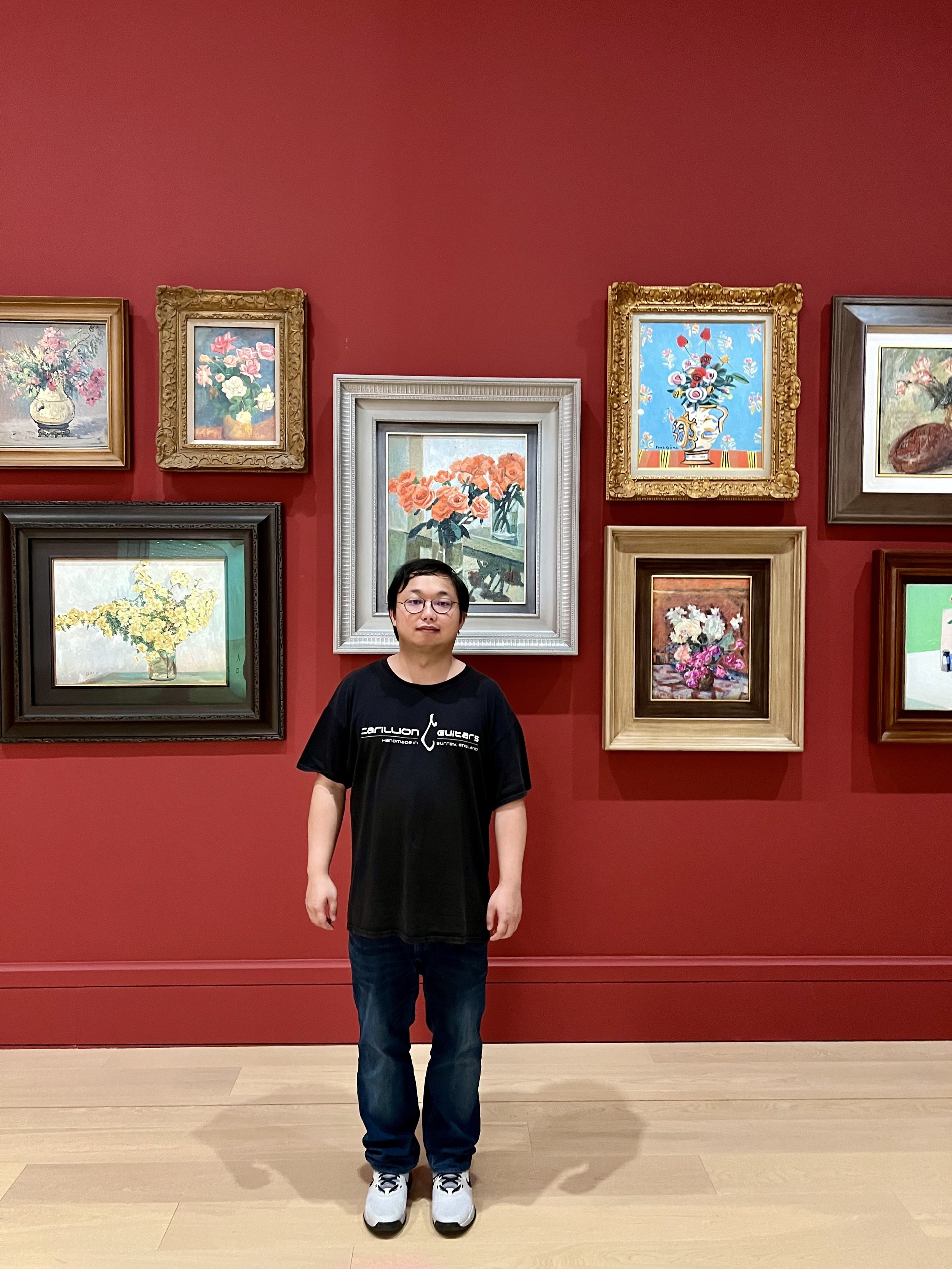
BIO: Yucheng Tao is a Chinese poet. His work has appeared in White Wall Review, Wild Court, Ink Sweat &Tears, Strange Horizons, NonBinary Review, Recours au Poème, and he is forthcoming in I-70 Review, North Dakota Quarterly, Poésie Première, and Arpa Poésie (2026). He received an honorary award from the Dark Poet Club, and his chapbook is forthcoming from Finishing Line Press.