
Five Poems
by Michael T. Smith
October, 2016
I sit on the porch, unseasonably warm
October weather -- and I’m wasting time.
Although that may be “wasting.” I don’t know
How every word we use isn’t in quotation marks…
Idiots want to dub these “scare” quotes, like a
Foreign language, but I don’t see
what they’re frightened of. Perhaps xenophobia
Perhaps multiplicity,
With a capital ‘M.’ That’s my favorite letter: ‘m” as in My
Name, but also in “Make.”
But as I was saying, so many breaths ago -- I sit, wanting
to see my family. Their faces, in different frames
stacked up. I want to record this to look at later
regardless of the present moment.
Because then it is affirmed and real.
There are those I love, I hope they know.
But I don’t
say it so – for fear of emotion or fear of closed doors
(I don’t know if the house is an analogy of the body
or vice versa. Vice – there’s an interesting word use. No?)
When are colloquialisms evil?
It’s at least the negative,
the ‘anti’ before it’s made ‘cool:’
That is ‘bad,’ ‘wicked,’ ‘sick,’ – do these quotes make you
nervous too?
The mundane makes me nervous -- not a careening coaster
but the slow turning of the world. Not the future
that has not come, but the present
I’m stuck in.
But perhaps I can take a photo and send it to you
And we can think of how happy we were now,
Or at least “happy” (be afraid)
for am I happy now?
Winter
Amidst of some sort of witch's hour,
I've wrestled with my pillow dour --
(Isn’t it odd how the sun’s rind,
tricks you when you’re trying to be so kind?)
As that cruel jester mocks me so near
how does it know my secrets -- my fear?
I can picture his face from dots of snow
(And I see it a 'him' counting between the au).
Dali said the sexiest part of a woman
was her secrets. So I know in syn’nym
the blinding snowflakes grow larger northerly bent,
feeding off my ever-falling discontent.
(everyone remembers that Shakespeare line,
but they forget the following, entwined:
"Made glorious summer by this sun of York."
But none there is, when Höðr the sun does cork).
The Dead
Their faces are the same --
because they were a company
outfit.
Dressed to the ‘T’
to be placed in a mausoleum
shrine,
with primped sleeves
and brushed fabric.
For the new-age dead
are just as uniform
as every box on (and off)
the wall-calendar.
My feet walked forward
Before I took a step – all steps
Laid out in a Gantt chart
marching down aisles,
as slowly as the rising
of the weekday sun.
The smiles you see are rated
higher than the ties,
which hung those sinners of the self.
And in this perpetual prison
with one door off,
holding within sweating flesh.
I sat within these three-walls
poorer for the money
I made:
savoir vivre fit on a PowerPoint,
a bulleted list to shoot down any –
hope, future, love, life…
And anon, no more – a post-it
eulogy. Not much said
for the identical dead.
The reports were stacked onto mounds,
stapled,
filed, meant to be shred.
But no one did the same
for the pitiful
dead.
Untitled #50
Ever about The The --
their small hands shook the sky
until the nails
holding it up, fell down --
glittering like the twinkle in her kohl eye.
His eye --
like the Chaurapanchasika,
wandered like a cow on a
path
not trodden. It bathed in a pool of light --
He, the face of can’t.
It said:
“Life is a pencil sharpener,
before the lead recklessly crashes onto the page,”
a bean curd
a spice to stick in the curd
a motion to make the curd more palatable --
Her eye –
like a wilted champak flower
wandered down to leave
the gods. It only exists in short
separations.
“Oh, recklessness of I,”
mouths of the country said --
to drink from her mouth --
she, with a hundred flatteries so heavy
they destroy the meaning of words
even now
What’s to say is said,
is said:
Words entangled his heart in a snare, like
Kashmir.
Little Man on a Rickety Boat:
(a poem on breaking up)
A coming go and coming row; because
cockatoos (are) sad but true; and now
“and now” falls from her canyoned lips
but the Mystery of stays -- hereafter
(referred to by) ‘punctuation’
remains.
“Your tongue has clothes ill-tailored”
(she had a tall vocabulary
but twas only words she used often,
her only dower).
Those clothes are tight in the mouth.
“Why should we do this?” She
asked rhetorically -- I think.
Love has an aftershave,
but --
but this Dear John has a detour,
calling each other ‘baby,’
while acting like children.
As datal clouds go sailing by
he asked with many an adverb:
“Baby, should we stay together?”
She said ‘no.’
He said ‘no.’
--But in entirely different notes
(just like a normal communication
where the sender can now live alone).
For love is like a fad --
Is an homage to the calendar
(Wednesday’s allusion’s, Monday’s trope):
A woman with (wet) dreams,
All open,
But never admissible.
Making love to your memory
(in an illicit affair)
I know our ship has sailed
off the flat world’s edge.
I know the past we had is like
lip synching an old book on tape
(with a shrinking n’ stitched tongue).
How different would history be
had Mona Lisa frowned? We
used to say different things
with the same words. Now, don’t
let me fool you, for masturbatory
kindness is in itself a “power play” --
two words that should be one,
reproducing the feelings we’re not.
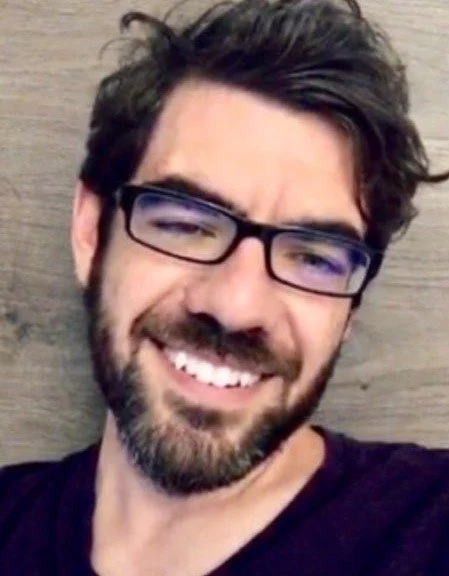
BIO: Michael T. Smith is an Associate Professor of English who teaches both writing and film courses. He has published roughly 300 pieces (poetry and prose) in over 100 different journals.