
Two CNF Poems
by Reed Venrick
L’Art de l’Espalier
Entering the Luxembourg Garden
From the Rue d’Assas side, I’m hurrying
Through to reach my first French class
Of the morning, I saw the terrain between
The dewy, open green and a statue
Standing under the chestnut tree—Charles
Baudelaire scowling at the world. Nearby
I see the fruit-garden-section with its apple
Trees designed in a linear and symmetrical
Arrangement with limbs branching out
From the trunk the size of a child’s wrist
With long-finger-limbs stretching to reach
The sun—because the climate of Paris
Is far north from that of sunny Provence,
And apples need the sun’s exposure
From the south, gathering as much light
As possible with open space below,
Allowing ventilation of limbs, shaped
And pulled into a candelabra design.
There I saw the results of an artist-
Farmer on his knees, where amenable
Apple trees were shaped and grown
Flat against the wall on one side, and
Nearby, another apple variety, secured
Flat against a trellis. There I saw *1
Those thriving apple trees each
Afternoon I crossed the park
On my way to the “musee,” where,
As a graduate student, I researched
French nature art, but later, when
The sun fell into the trees and leaves,
I re-crossed back through the sculptured
Rows of that petite apple orchard,
I saw that growing agricultural fruits
Could also create a sense of beauty.
Hadn’t I seen those linear, vineyard
Trellis lines flowing over the slopes and
Undulating hills of Burgundy? And a short
Train ride to Versailles—those magnificent
Orange trees Louis IX had his gardeners *2
Grow in ceramic pots? But at the edge of this
Park, this process showed it was possible
To achieve an essential element of art theory—
Minimalism—simplicity stripped down,
Reducing the tree not just to its essential
Structure of trunk, limb and leaf, but
To trained branches, creating patterns
That also highlight negative space. *3
“Fine art” in a museum does not combine
The aesthetic with the functional, for
The process of growing an apple
Tree flat against a vertical plane and
Supported on a staked frame to give
The two-dimensional form, allows
For a concentrated space for a fruit tree
To grow in an urban park, and it makes
One wonder if the great Louvre would not
Be well served with a touch of practical
Utilitarian; after all, were not the designs
And colors of fruit and vegetables
With their range of colors and designs once
Seen as gifts from the Greek and Roman gods?
Perhaps that famed museum barely
A stone’s throw away—across the River Seine—
Would be well served with a wing to add
To its’ Mona Lisa and Venus de Milo rooms,
Some of the most visited “terrain” in the world,
And a new wing could expose the French
Art of combing the useful utilitarian with
The beauty of the aesthetic—the espalier.
FOOTNOTES:
1. Apple trees with “spur branches” do best for training
To espalier. In France, varieties such as “pomme du limousine,”
A golden delicious type, and “Calville’s Blanc Hiver,” known
For cooking, are known as excellent candidates for espalier.
In the USA, Macintosh and Fuji are favored candidates.
2. The royal gardens at Versailles perfected the growing process
So that the palace’s “orangeraie” could be watered
On a schedule to make the orange trees blossom on time
For King Louis XIV’s dances and balls.
3. Negative space—the space around and between objects;
Focuses not on the object, but on the space outside and
Between the objects—A “silhouette” shows an kind of example.
LEAVES FOR FEATHERS
“In this world, there are many illusions, but the greatest
Is the illusion of separation.” Albert Einstein
What meaning does a spectator perceive from this
Painting of Rene Magritte’s? “The Natural Graces,”
Showing a flock of birds—clothed not in the expected
Feathers, but leaves. Leaves. How to make
Sense of this surreal metaphor? Is it a joke? Is it
Kitsch? How to interpret four doves fluttering,
Growing not feathers but leaves from trees?
What is the intention? Signification? Do we witness
The fantasy of an artist remembering his ayahuasca
Trip? The memory of an psilocybin hallucination?
Has he made the connection to a higher-level
Consciousness? But a spectator has to ask: if…
We see this painting as a philosophical metaphor,
Then, is does the artist refer to time? That in a billion
Years, say, the fabric of leaves, oak or elm design,
Could form the protection of a bird’s bare body?
Or another way to wonder: what chemical reaction
Would it take for feathers and leaves to merge into *1
Wallace Stevens “one?” Is this painting an imagined picture
Of transference evolving beyond a human’s sense
Of time? Could evolution fast-forward at the speed
Of light? Or warp-force beyond? Merging with or
Transcending Darwin’s theory? And what if…
Humans are moving across this arc of space,
And what we call “evolution” moving in a different
Direction from what we imagine? Implying even
That “time’s change” for some may not be moving
In a cause and effect paradigm—reviving the ancient
Philosopher’s debate—but life’s existence may even
Land on another potter’s wheel, where the circle of change
May roll counter-clockwise, and the image of a dove
Growing leaves for fight and flight may show transcendence,
As the observer Einstein once noted—many illusions
Exist and even glide ‘round this magic show of embodied
Life on this spinning globe called earth, but the greatest illusion
That we humans suffer is the illusion of separation.
FOOTNOTES:
1. I leafed through Rene Magritte’s “oeuvre,” I looked for a grove
Of trees, where doves clothed with leaves sat on tree limbs flush
With feathers—I.e., a philosophical reversed mirror, but
To my surprise, found none.
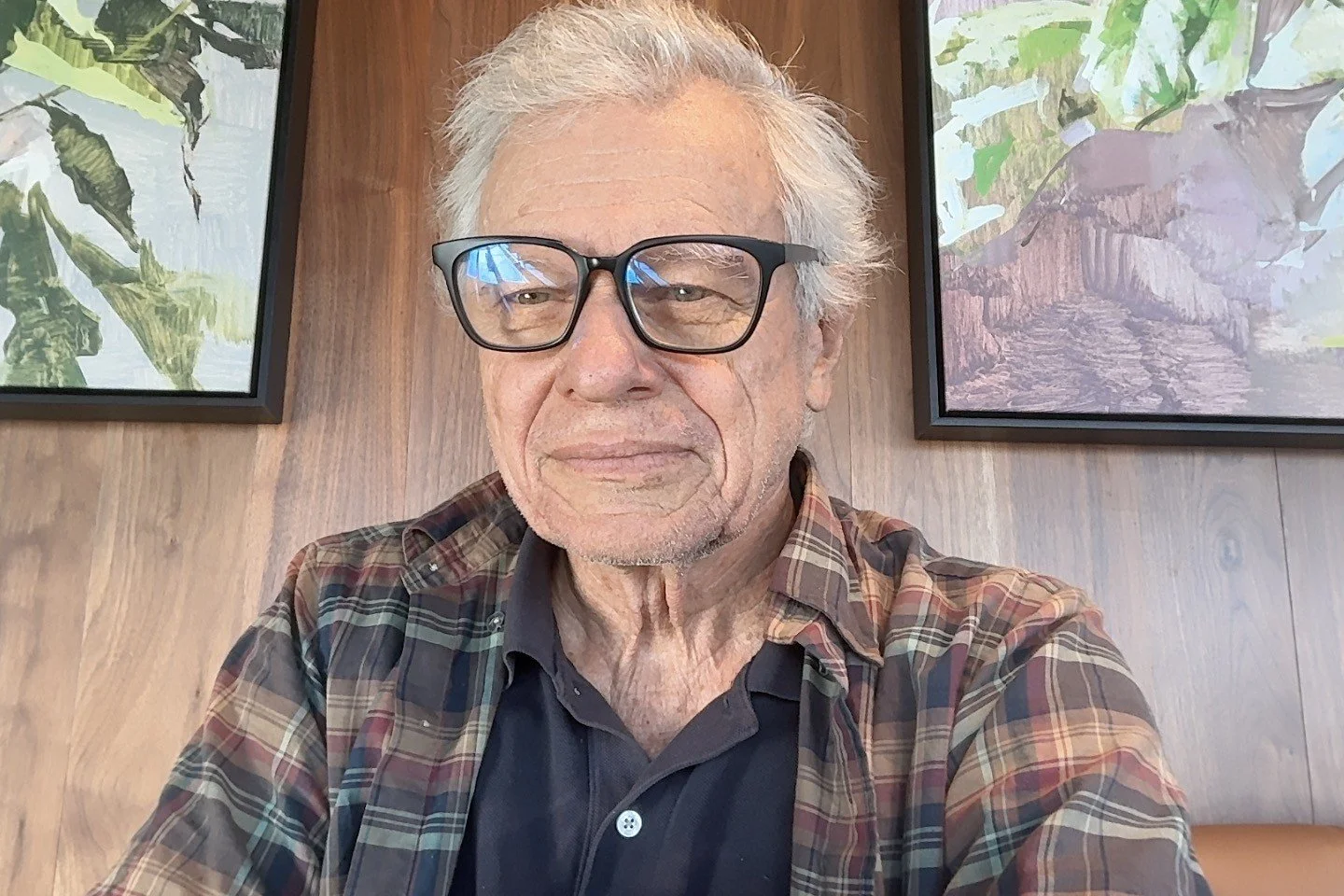
BIO: Resides in Aix-en-Provence, just a short walk uphill to Paul Cezanne's former home and studio; writes on French language and culture,