
Six Poems
by Douglas Twells
LIGHT REPLACES OBJECTS
IN SAN FRANCISCO BAY
Lights double, triple, elongate in the bay
and other waters nearby. Commerce
would have crowded together, if permitted, all
of the means for profit - mine, quarry, factory,
warehouse, office building, distribution
center - retail and wholesale, plus institutions
that meet our peripheral needs which seem to be
legion - libraries, jails, museums, schools,
churches, hospitals - to name only a few; but here
geography prevails and prevents this blight
from spreading according to its own whim. Here,
the lowliest trades wear beauty and grace acquired
from each lingering wave, each climbing
hillside, each vista of shore or mountain opposite.
All of this becomes by night not
buildings, not roads, not groaning vehicles,
but light - a profusion, a multitude moving
and at rest, or distant and shimmering, of individual
lights. This is the truth, this is all
there really is. The day is false, a mere filler
to separate and showcase each magical
night when we learn reality is light.
MARCHÉ AUX PUCES
Place du Jeu de Balle, Bruxelles
End of the day. No vans.
Moroccan, Tunisian,
Congolese, bruxellois—
all the vendors gone.
Emptied, nothing now the square—
jumble of over-sized bricks,
dirty, black and gray, uneven,
given to tripping the unwary.
You’ve finished your drink,
paid your tab at the café.
Why sit longer this way?
And where are the girls?
Stooped and picking
cracks and crevices,
hands disturbingly filthy,
your granddaughters collect
trinkets and baubles,
bits of this and that,
stuff they’ll pocket and keep
or lose or their mother
will find and toss
before they end in the wash.
And what’s keeping you,
last one in the emptied café?
Stooped and picking—
from where else?—your brain,
the cracks and crevices, gray,
uneven, given to tripping,
finding bits of this and that,
baubles, trinkets, making
notes on cards you pocket
for poems you’ll keep or toss.
THE ALASKA BUILDING
Creeping trains in downtown Seattle
sound soft horns at 3:00 a.m.
They serenade insomniacs - travelers
who stir in their rooms in the Alaska Building.
No dinner, no drinks, they landed late,
got checked in, found their rooms,
bodies still set to Eastern Time.
Trains comfort and set them dreaming.
Here’s history written in masonry and steel.
Beneath the rehab, the hotel renovation
that likely preserved it, the Alaska Building’s
impressive features mostly go unnoticed.
For once don’t rush – note how white marble
lines the majestic elevator lobby.
Step in the stairwells and there it is again –
thick, white marble! Banisters
and balusters line the way up.
Find the brass box - marked ‘Mail’ –
near the elevators, and the glass chute
ascending through the ceiling – a mail drop!
Take an umbrella and stand across the street.
See the façade, a Beaux-Art beauty!
Fourteen floors from 1904,
a Gold Rush relic, banking barons
backed it and made the Alaska Building,
Seattle’s first skyscraper!
Daybreak! Suited, serious, intense –
those travelers descend, rush the café,
then hit the street by foot and taxi.
All day long, an immigrant staff
will vacuum and clean, change towels
and sheets, scrub and polish, then vanish.
Now evening, travelers return, weary,
worn, day’s work done, they drink
at the bar, swap tales on hotels and flights.
Finally they retire, take to their rooms,
plan the next day, catch the news,
read a bit, drift into sleep, and dream:
A tall ship from Seward finds its port.
Down the gangway, old prospectors descend.
However weary and worn, they’re hopeful
as they haul heavy sacks to the bank for assay.
As for the leading citizens, they gather –
in the penthouse - over bourbon and cigars.
There they admire their city from its tallest building.
For those travelers who still turn and toss,
soft sounding trains creep along,
comfort, and serenade them back to sleep.
BLAME THE CAR
flying over Anytown, USA in the afternoon
Chance or sixth sense,
turn from your book
and there it is,
all the sprawl,
unbound, untamed,
uncontained,
the essential,
the endless
American City.
Forget the several spikes—
concentrated capital—
at the empty center,
one thing on the ground
standing at the curb;
from the air
a trivial diacritic
for a populace
splattered across the plain.
Blame the car for this:
it flings malls
and rubber stamps homes.
Work, school, after school,
PTA and back—
it hijacks hours
and reroutes love.
Grab that wheel!
Hug that road!
Space to call your own
even if you’re never there,
freedom and dreams
drain away with gasoline.
Erase the family farm.
Every city a Motor City.
Where does it end,
find its center again,
the city contrived of cars?
MIDWAY AT MIDNIGHT
In preparation for landing, turn off all electronic devices.
Return your seatbacks and tray tables to the upright position.
Stow all carry-on items underneath the seat in front of you.
i.
Striding your silken paradise,
you marvel at the work - brocade
in gold on black – lattice, vine,
and vase, paisley and arabesque,
intricate yet not to excess,
subtle, delicate. You turn and nod.
Your bursar hands a velvet bag
to the old man cowering near the entryway,
the craftsman, weaver of this world.
For a time you enjoy your time alone
with this magnificent work.
For a time you savor the idea
of envy in the eyes of visiting sheiks
and emirs. And for a time you sleep
without a worry for your fortune.
Times however change. Nothing
stays the same: envy and deceit
threaten. Waking never ends.
What’s the value of a sultanate
to a sleepless sultan? Pacing
at midnight up and down your carpet,
you pause, step back, breathless,
halfway across your assembly hall.
You ponder for the millionth time
the central feature - where patterns
swirl and wrap ‘round an intricate
design – in your eyes a flourish
of feminine fingers draped in gems –
hands held up for admiration –
in fact the glorious medallion
at the center of everything.
Distressed lest another magnate
grow jealous and covet your carpet,
anxious that one night thieves
and assassins overrun your camp,
Your Eminence has nearly half
shorn ‘way, sectioned, and,
most graciously, bits passed
among the subjects. As for the weaver,
another worry, a heavier bag
of velvet and, with missing fingers,
one-way passage to a foreign land.
Now you and only you, have seen
and you alone possessed perfection.
ii.
The plane homes in cutting
north, then east, south, then west -
Chicago from the sky, the night sky,
clear and dry, a landing pattern
that lingers long above the patterns
on the land, and the lakeshore
that terminates the pattern, cuts off
the light. The outer drive defines
the edge where habitation ends
and there begins an inland sea
reaching all the way to Michigan.
The fortunate, those with a window seat,
those in the darkened cabin who aren’t
asleep, see the city not as city.
No week’s work, no flight delay
can weaken this aerial wonder,
the woven world of other artisans -
Burnham and Sullivan, Khan and Jahn.
Make no little plans!
Soon enough sodium vapor
lamps, bungalows in rows,
trash cans lining alleys, a child’s
tricycle in a back yard. Soon
enough a startled face in a car
on Cicero. Soon enough
reality - wheels will screech and engines
scream - the pilots try to stop
this thing. For now there’s time enough –
time enough to doff the turban,
time before the magic ends –
this landing Levantine.
PARKING GARAGE, AFTER WORK, SUMMER
i
If the sun were flat,
a blazing circle on a backdrop,
and this multi-story parking garage
a cut-out that pops up
in three-dimension
when the card is opened,
and if the card were opened
on the hottest evening of the year,
ninety-eight degrees and humid,
say at 6:30 p.m. when
nearly everyone else has gone home,
then, briefcase in hand, you
could be the sole pop-up person
striding across the street, happily,
fixed free in still-life until
someone closes the card.
ii
If your shoes were glued
to the sidewalk
beneath your feet
as you passed the pines and
prepared to cross the street,
that too would provide you
an appropriate excuse
to stand stock-still before
the eight-story garage
now, certainly with the exception of
your car, emptied of all the day's
traffic, and admire far longer
than you normally could
the alternating sunlit walls
and dark floors, vacant now
but formerly filled, and
you could cast your own growing shadow
(Here's movement!),
lengthening to meet the shadows
of the long-needled pines
and make angles across
from the parking garage; but
there is no glue.
But if there were, and,
if someone, another straggler
or the security guard,
asked you what you were doing
or offered their assistance
in helping to free your feet
from the shoes (if the shoes
themselves could not be pried loose),
you could say,
"Thank you very much.
Most kind of you.
I am merely paying
homage to Edward Hopper."
(Or Ansel Adams,
or some such thing).
"And I apologize for
any inconvenience
I may have caused you."
That is, if there were glue,
a guard, and cause. Otherwise,
you could stand still
and remain silent.
iii
How could you have neglected
to mention the air? - so thick,
so heavy, heated by the all-day sun,
now well off its center;
but the heat remains, undiminished,
maintained into evening by asphalt,
concrete, and steel and trapped close
to the earth by exhaust gases;
the air, the air, all the more palpable because
since morning you've been sealed away,
insensate, in an air-conditioned building,
whereas, now, this air, the sparrows'
evening air, is unsealed, unconditioned.
Ah! The sparrows! Note how they play
and carry on in the pines!
Hard to believe at this hour -
they must be there at other times,
certainly in the morning,
but no one could hear
above the din of traffic,
lawn mowers, edgers, aircraft,
and the mental din of worry
and day's work beginning.
If you stayed stock-still,
stood all the night,
you might detect them,
at their first song, in the morning,
and see the dawn drift down the street
and up the side of the garage,
before work, in the summer.
Otherwise, no way to know.
But they're here now,
just the sparrows, and you,
after work, summer.
iv
Summer is over.
So caught up are you
in autumn responsibilities,
constant, unrelenting,
you wish you were in Morocco,
Tucson, or Mexico,
somewhere and possessed
of the wherewithal
so you could build
an eight-story parking garage
in a desert replete
with reliable light and heat,
possibly, ideally, sparrows,
no helpful passersby, no security,
and not a single other parker -
your car alone shall occupy it.
Then, standing near it,
in it, or on it, or seated
quietly in the heat, you
could cease to think
or stand or be
anything, all the busy
moving things of other
places, other seasons,
and stand stock-still,
silent, among the shadows,
forms, and shapes
of the parking garage forever,
after work, summer.
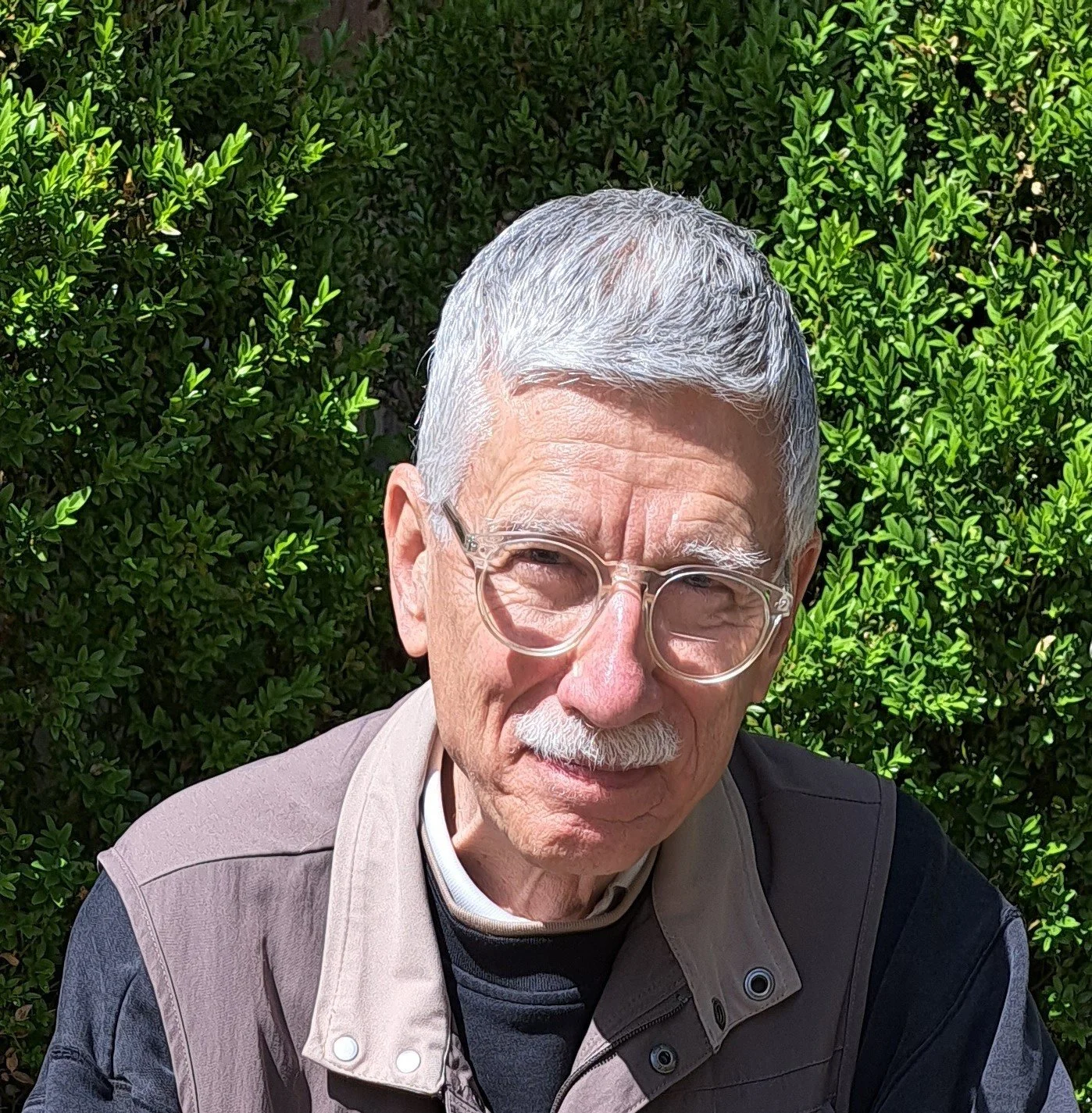
BIO: Retired from a career in university administration, Douglas Twells continues to write poetry and study ancient Indian literature. His poems have appeared in several journals including Spotlong Review, Scribeworth Magazine, and The Metaworker Literary Magazine. Twells and his wife divide their time between St. Louis and Chicago.