
No One Here Gets Out Alive
CNF by James Ross Kelly
IT WAS SUMMER 1970, and she worked at a topless bar an hour’s drive north of San Francisco. This was a working-class topless bar in a Northern California suburb, with a jukebox, red Formica tables, and two dancers who alternated between a footlight-lit platform and pouring golden draughts of beer from chrome-plated pumps. She was a country stripper with a good hippie heart, and her name was Vivian.
Coins would go into the jukebox, and eyes, some ogling, would peer through the cigarette smoke and turn toward the dancer. Mounting the steps as a low bass thud vibrated the bar, she would, in a graceful yet never tacky manner, begin as if entering water. She’d emerge with a shift of a shoulder and a slight half-round motion of a thigh, the tips of her fingers barely brushing the backs of her hips, and she’d begin to dance. Perhaps it is now awkward to write about this electric, sensual time. However, the first time I heard “Oye Como Va” by Santana, she was dancing.
I remember a small bra with tacky gold lamé tassels catching light on gold wire-framed glasses, auburn-red hair spilling long and straight to just above the crack in her ass. The thong was yet to be in vogue, but bikini panties were the dress code. She didn’t tease. Laughing, she flashed bright teeth, head back, breathing deeply, laughing again. I want to remember it in the present tense, like how she plowed perfect arcs in the air with the near-perfect peach shape of her ass, each hip rocking to a beat that is there, arms stretching behind the rhythm (the motion is totally hers). Now, arms move imperceptibly from behind, and in one swift motion, breasts neither small nor large begin to ride in an undulation with her smile; she has a smile of joy—a smile of joy and rock and roll, and yes, her breasts are perfect. As I say, I want to remember this. Like remembering the taste of a Camel cigarette just lit off a Zippo lighter, even though I stopped smoking in 1990.
I’d been drinking beer fast. It was half an hour until closing, and to go back and put myself in that place, I’d come here after a late-night shift on a military base I was supposed to be part of—in 1970, “back in the day.” If I’m remembering it now, I’m unwinding, taking it all in, and talking to the other dancer, whose name has long since slipped into remote gray matter, but who I’m interested in—she’s pert and conventional, with large breasts that have a few more years, yet they aren’t perfect either.
That night, Jim Morrison asks to have his fire lit from the juke. “Come on, Baby, light my fire! Try to set the night on fire!” I’ve secured a breakfast date with another woman with large breasts, but Vivian, dancing, has everyone’s attention, and she is seared into my memory banks from fifty years ago—when I sat there, ordering beer after beer.
After returning from an eighteen-month overseas military assignment, I had written off Vivian in that lack-of-confidence way that puts distance between wanting and the reality of encounter, and what was then, the days and nights of all-male banter and quip—Vivian, the beautiful Vivian, was the playmate, perfect, an icon, seemingly unobtainable, as I’d relegated myself to finding whores in overseas bars, yet I wrote letters to my Catholic bride-to-be on the East Coast. Images coalesce, fade, and become one with juxtaposition, especially when slick magazines sell all the temple goddesses naked and flat on pages, while back then affordable whores were procured in backstreet bars or across oceans in exotic foreign lands. Then thought and desire became an ephemerally concrete, touchable presence. The thought of a woman, in its essence, will sometimes, from sheer loneliness, seem like it will lift the top of your skull off, yet libido is a necessary human attribute as real as your arm or leg.
That night there would be a late-night breakfast, and I would learn that this woman with huge breasts was living with a real estate agent who had a pool, the basic high-dollar amenities, and a seven-year-old somewhere between other scenes, with alcohol or too many barbiturates. The lust would wear off under the glare of neon diner lights, and what could have passed for sex with her would eventually become unimportant. We went to our separate vehicles.
The summer grew hot, and there were a lot of late-night drives to the beach, and Southern Comfort with its silky, sweet, medicine-like glow that helped the waves come in. Every few nights after work, several of us would show up and check Vivian out, with the other one, large-breasted and quiet, drinking—hardly on the make, yet never giving up either. And then there was this night when their bar and our show had to close for some reason, and I was out at another bistro, dancing with the pert, buxom, short, topless dancer with all her clothes on and an ample amount of gin, listening to a bad rock and roll band. And in walks a friend of mine with Vivian.
I’ve scotch and water to my face, but the way she is walking the length of this bar in a green miniskirt, with her hair almost to where her hips are rounding out, there is a lump of some emotion in my throat. She’s sitting down now, mouth full of teeth, smiling at me, and I know I’m not ever going to get more than a hello out of my mouth all evening.
My speech is haltingly glib with one-liners and opulent mannerisms, but the contention is all about the women, loud music, and alcohol. Vivian has not taken her eyes off me, nor mine from her, my friend gesticulating as he gets drinks and pays for them; he asks her if she wants to dance as the band plays something slow. Without looking she says, “Yes, but with him,” as she points at me.
Finding touch and movement within arm’s reach, looking into incredible eyes framed in gold lenses, blue even in the green of the dance floor, there—what is happening completely by itself makes nothing else seem cheap or mean any longer; there is a point where the insouciance of lust leaves, focusing simply on the man and the woman of it.
Expectation becomes electrified, meaning reality seems to hold the possibility of being good and warm. Our movement together crowds out coincidence and pretense. Everybody else seems to take care of themselves, and later I kiss her. What could happen seems not far from stars and maybe quantum leaps toward justice as she whispers, “Tomorrow!” Tomorrow is always the next day when all goodness is made, and the conversation of the night goes on, floating past our very own existence. That she made this date with me for the next day, without offending my friend or hers, seems a bit of art I’d not seen before.
That next afternoon, I met Vivian at the intersection of two rural Northern California roads. She arrived in a dented, paint-peeling 1953 Austin convertible, with a large Great Dane in the front seat, its head sticking over the windshield, its nose straining for an aerodynamic advantage. Without stopping, she motioned for me to follow her up this winding California road, somewhere near the coast and the small creeks that empty into the Russian River, which, low and green now, had its constant traffic of flocks of summer people. I had met her at the intersection of this small winding road with the more well-traveled highway, and she was leading me away from all this. There had been no word: a bright smile, the Austin spinning its tires, and the Dane’s unclipped ears that started to flop as the wind whipped them faster as she picked up speed. And Vivian’s long, reddish-brown hair flew back in circles, and me in my springy ’62 Nova, whining its fourteen-inch tires on the pavement on this dry summer day, not exactly sure where it was going.
But she—after only three or four miles—led me to a brown, oak-laden bluff where a ravine ran abruptly under a bridge with parking space for two vehicles. We parked. The Dane jumped out immediately, pissing, slobbering, and circling the whole immediate area, smelling me and jumping as high as Vivian’s head as she came over with an open Budweiser in one hand and a joint in the other, both of which she handed to me, then put her arms around my neck and kissed me several times as her breasts pushed up against the lower part of my chest. This was now beginning to feel real, and as romance, the heart-pounding uncertainty of passion, had up to that point in my life found few more concrete places to abide, I was lifted from the bottom of my feet to heights I had been sure all along existed. One’s own libido has the immediacy of producing high-elevation altered states. But I had been a dweller on some flat emotional plateau far too long, where there were only rumors of this, half-believed, as women and girls seemed to come and go.
There was another woman on a distant coast whom I was supposed to marry, and yes, I’d felt the same way about her; there had been romance and sex, but there were also soap-opera machinations and social trappings that kept you paying out in one way or another, just as the whores across several oceans had done for cash, and I was clueless as to which, in the grand scope of things, was the most honest transaction. The East Coast transaction included the Catholic Church, whose honesty was not beyond suspicion. This seemed honest, real, momentary, and abjectly passionate.
Vivian was the original California hip woman, in her gold wire-framed glasses, and what she was about to give me in a graceful way, as we started down the ravine with the Dane ahead of us, was totally and completely free. And it was, for a brief time, love. Somehow, I’d missed the Summer of Love when a draft notice showed up. This one afternoon made up for it. We stopped several hundred yards uphill, popped open two aluminum Budweiser cans, and she reached into a bag and took out a quart jar filled with hundreds of charred roaches left over from serious marijuana smoking. She emptied the contents into a rolling paper as she held the jar between her legs, then rolled the paper and its contents deftly into a tight little cylinder and popped it into her mouth, where she lit it with my Zippo lighter, inhaled deeply, her nipples protruding beneath the red t-shirt she wore, and then handed it to me.
The dry, crackling heat dissipated in a breeze that came up the ravine; I filled my lungs with smoke and exhaled my whole being as Vivian pulled off her T-shirt. I was, for this moment, looking at this topless dancer’s breasts as if I were a chaste husband and the only man in the world who had ever seen them. We sat, talked, and finished our Budweisers. Then she took my hand to lead me a short distance to where an ocher-brown mound of grass protruded from the tan of the dried, unshaded green, and laid down a red-print cotton cloth in front of a rock outcropping that looked like a clamshell that had tried to rise artfully some long time ago. The dry ground where we lay seemed to cushion our bodies as, beneath this August sun, we touched, kissed, and began to slide our hands over one another as sweat began to glisten with the slick human lubricant of making love; the thigh of it, the tongue of it, the tongue-tipped nipple of it, the rising up to focus each other’s eyes to see and feel the inside of it, the real unseen, only to go down and see and taste the openings of ourselves or the very place where we most completely forget; to leave off the conscious movie of our minds to be, and to have inside us the full emptiness of our being, and yes, she smiled and laughed and so did I, and gave in to every thrust and pull, backs arched and her body shone with luminescence, with these tanned breasts with nipples to be kissed, erect, to leave off and again go down to kiss again the auburn-enshrouded enclosure, intrauterine salt-sweet smell and taste, while vaguely seeing her pelvis roll with each touch and taste, and then back to enter, become, and then come with her—in her, on that hillside under the sun, just as it’s been done everywhere, always. And then again, in its own way, it was a single, unique, irrevocable act, as it is to everyone, over and over again. We continued to see one another; we became friends. It was never as spectacular as that afternoon. As I said, this was 1970.
There was another topless place in Santa Rosa, “The Marble House,” with more supposed class, but it was far seamier, with a dark quality all its own. This was not entirely because it was a topless-bottomless place where customers came for full female nudity. A lit stage kept a constant line of women taking it off to rock and roll, then returning to the throng of customers for drinks, among Elks, Shriners, truck drivers, white college kids, general drunks, all equally perverse and normal at the same time. All the walls were painted black, and the footlights, stage, and bar were all presented at the center front. An upper-level back bar was staged for a more intimate presentation.
Some were on the town, some a night away from their wives, some pounding tables, some just sitting there. We were GIs there for the scenery. All patrons were there for the scenery, however, with every song on the dance floor, a change in the music as more drinks are poured, different dancers and more banter exchanged, and another woman gets the spotlight, as alcohol is passed through a succession of human tubes, in an all-male conflagration of uneasy lust with no immediate outlet other than streetwalkers an hour away in San Francisco (which perhaps is where more honest transactions could take place); a constant pumping of testosterone from a hundred million inadequacies, where the male sexual rite is performed at a tender age as a first act in a bathroom—alone. This is turned into exploitation and the jive commerciality of the erotic so that many never come close to love and sex. Sometimes rock and roll became an antidote to that, sometimes not. The human ocean is not a regulated coming and going of the tides but is often a vast surge only barely restrained (and then only outwardly so) by the fetters of politics, religion, currency, or war.
Back then, we were there as GIs, and like all the rest of them, many of our fathers could not explain to us that women were keepers of the next generation and were to be cherished and loved. Even the strippers wanted to be cherished and loved; they were all someone’s daughters. No one had explained that to them either. No one ever told any of us that sex was an appetite to be controlled and used in love. No one told us that we were responsible for our own biology. No one told us that our genome, each unique, was a message in a bottle to be opened, perhaps revealing something from another world. This, too, was another war being waged.
I went there on a summer night in 1970, with this large-framed Iowa guy, blond with a crag-like face, cratered with the scars from adolescent complexion, complete with blue eyes, all of which manifested in a not-unlike-John Wayne manner, an easy, slowly good-humored way that could quite possibly be dangerous as well. He would go to the Oakland processing center to be sent to Vietnam the next day and was not welcoming these travel plans in the least.
The back bar was on a slightly elevated level that ran parallel to the stage, with a table, and was mostly for daytime business, but at night it was tended by a platinum blonde with a less-than-wholesome Lee Remick appearance who, between serving drinks, would dance on a platform attached to the middle of the bar, in front of rows of upright bottles of gin and bourbon and the rest of it, all waiting to provide a little comfort and a little death at the same time.
This blonde was the movie star of the place and would always make an impression when she danced, and depending on the music and the tips, sometimes she would be better than others. What was there besides sensuality was only the way she worked, almost nothing behind the bar, with an ability to change into completely nothing in a moment, the way she would turn a cheek while keeping her eyes on you as she would purse her lips while making the change. When she took to the small platform at the center of the bar and took off her bra with quite a bit of show, deep pelvic thrusts rippled her ivory body into curves, and then her ass would tighten, and we who had been there before knew that eventually she’d unsnap her panties and the skimpy bra would be flung to the back bar, and full nudity would float free as she raised her hands in the air; arching back, she would take steps with her long white legs, always in perfect time with rock and roll, and then at times in the less-than-bright light you would see, or think you saw, something wonderfully pink in the midst of blondness. This male thing of looking at female things has been around since the cave times. It is driven by a sex drive. It is neither profane nor sacred. Neither feminists nor fundamentalists can make it go away. It will always be integral, in the sweet married love beds or dives like this one. It is always there.
There were four bars in the place, but the real show was where she worked, and where we’d taken my Iowa friend. I’d shared another foreign duty station with him and shared whores in that far-off land, but he was now going to Vietnam, where they were really killing us and we were really killing them. There were no prostitutes in this little Northern California town. This topless-bottomless bar was just like a loaded gun.
So we sat there drinking, smoking, taking it all in—he’s exchanged glances with her, and she’s exchanged glances with him. He’s liking it; she’s at least pretending to like it. I’m a little bored. The music isn’t loud enough, and it’s bad. I’ve seen all of this. She’d done this to me, so I knew. It was a game she played when the mood was right and the right person was involved. She didn’t do it for everyone, but it was always for money, and not everyone would pay. She was a working girl and knew who would pay.
“I’ll show it to you for money,” her wry smile said without words. My friend had no idea what was about to happen as a tall Collins glass, quite empty, was set in front of him, and he was met with blue eyes that matched his own, full-bore, in the face that would seemingly swallow him up.
As she takes the platform one more time, the Doors begin to play “Five to One.” The bass is thudding, and I begin to pay attention again. By now, he probably has enough to remove that heady feeling that yearns to be where the opposite sex is. The thought for the moment is a non-equivocating point of reality. Now she, this very white woman, begins to dance. So here come more deep pelvic thrusts in time with the thudding bass from the speakers. Reflected in the mirror in front of the bar, giving a double vision of liquor bottles and a full view fore and aft of struts and shakes, plying the smoke-filled bar with her ass as it bends and twists with the music, a small black triangular cloth hides what we assume is a feathery whiteness as blonde as the hair over her shoulders. She unceremoniously takes off a sequined bra, which drops at her feet.
I leaned over and put a five-dollar bill in the Collins glass in front of my buddy. She almost immediately takes a three-foot stride to step onto the bar in black high heels, directly above, and peers down upon my friend, who, looking up, catches on and puts another five-spot into the glass. Her thighs are supporting her body now, and the gyration of her hips seems to orchestrate the music from our point of view. Morrison bleats, “Five to One, Baby, One to Five! No One here gets out Alive!” We’d seen The Doors do this number at Bill Graham’s Winterland in San Francisco in February, prior to this evening. The smoke, the clinking of glasses, and hard-driving rock and roll permeated the air. My friend puts one more five-dollar bill into the Collins glass, and the music and an incredibly apt torso bring the apex of this twerking triangle closer and closer to his face, which is now becoming a little paler than it normally was. His imagination dissolving in the cigarette smoke as it exhales out his nose, the smoke curls around in blue wisps through the lines in the form of her body, close and approximate to form, a presence not to be known as that night of possibilities rode on for him. She was showing him what he wanted to see. But that night she would never let him do what he wanted to do.
Six months later, he would walk across a compound in Southeast Asia, protected by Marines, who in turn were protected by a battalion of Republic of Vietnam regulars. It was supposedly safe duty, just sweltering heat. Then six more months, and he’d be home for good. He would be walking from a mess hall to an operations building when a Soviet-made rocket launched from twenty-four miles away would blow him fifteen feet into the air, where he’d land in mud and shock, no real pain, just that twilight zone of body shock where everything is curtailed in bits of noise, protracted and clear, and memory brings your life in front of you.
A mother somewhere in Iowa who held him, several lovers who had held him, a series of dreams and aspirations that had held him, and his laughter and humor that had held several of us. Is it sweet, precious Jesus who still holds him? Or the pervasive nothingness before birth, before memory?
It is pervasively sad either way. That night in Vietnam, in shock and unconscious, he writhed eighteen inches from where he landed, and the life that had been with him drained away in the mud and humidity into a dimension that is neither counted by any odds we really know of, whether five-to-one or one-to-five.
*from Kelly’s book Above Neil Rock: Stories and Poems 2024.
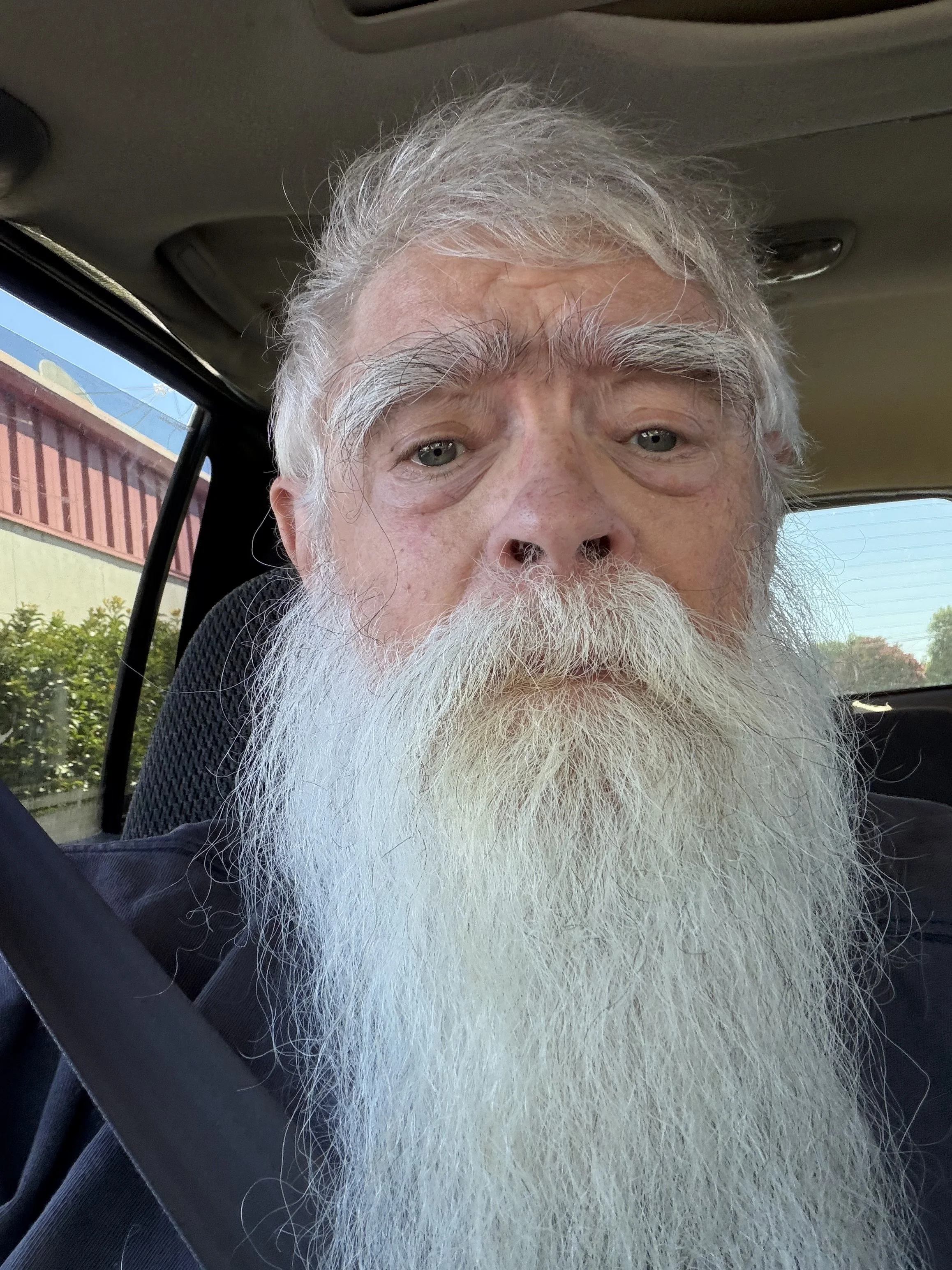
BIO: James Ross Kelly lives in Northern California next to the Sacramento River. He has been a journalist for Gannett, a travel book editor, and had a score of labor jobs — the in-between jobs you get from being an English major. He retired as a writer-editor for the Forest Service, where he spent a decade each in Oregon and Alaska. Some other presses that have published Mr. Kelly’s work include Silver Birch Press (Los Angeles), The Galway Review (Galway, Ireland), Blood & Bourbon (Toronto, Canada). Jame’s book is available at https://www.amazon.com/dp/B0DKJGRZ8R.