
Hey, That’s No Way to Say Goodbye
by Madeleine Foster
No one knew who first suggested it, but everyone agreed: Laurence Rutherford would need a fiancée.
Laurence wasn’t shocked by this. It made sense, really. It would make him more trustworthy, more worldly. More real.
He had only been involved with the SIS for a short while. He was head-hunted in spring 1967 by one of his tutors at Oxford – it was never clear who. Shortly after he graduated with a First Class in Modern Languages, he received a clandestine summons to Century House. He was twenty-two with no real plans for his future, plus a fluency in Spanish gifted by a cold but much-cherished late mother. When a spindly bureaucrat with a lisp offered him a post in Santiago, Chile, he saw no reason to refuse.
Laurence packed his trunk and abandoned the weeping September stones of Oxford for the smog and cacophony of the swinging capital. The SIS leased him a studio flat in Lambeth, with a window overlooking the area’s brash prefab sprawl. He spent most days wandering Westminster, admiring its august fatigue, and in the evenings lingered at music bars and all-night cafés, dazzled by neons, traffic and miniskirts. He drank and chatted to strangers, took girls home once or twice, and, overall, evaded loneliness well enough.
The team at Century House pieced Laurence’s alias together quickly. He was to enter Chile as an exchange student named Luis Rivera (close enough to Laurence, in case he ever blundered). He was given a Spanish passport – his hometown nestled in orange-hued Catalonia – and a student ID for the University of Chile faculty of linguistics and literature. And he was given a contact – a tutor at the university who would guide him in the SIS’s black propaganda operations.
From there, they constructed the myth of Luis Rivera: a schoolteacher father; a dead mother (torturous to contrive a living one); a drifter, with boyish aspirations to travel and to write. A lover of The Rolling Stones and Bob Dylan, and an avid reader of Pablo Neruda, Anthony Burgess and Jorge Luis Borges. They stripped his prim, private school polish and dressed him in jeans, patterned shirts and Chelsea boots. He grew out his mousy hair and had it chopped into something more jagged, more perfectly careless. And that’s when one of the bureaucrats suggested that Luis should have a fiancée.
Ruth did not volunteer herself, though she had seen Laurence a few times at Century House and always enjoyed looking at him. Especially with his new haircut. She worked in the clerical staff, and often saw him drop by for meetings. He always seemed a little irked – his brow creased, his lips stiff, his grey eyes hard. But it was clear that beneath his serrated reticence was total terror. She could see he felt lost and it endeared her, along with his soft voice and lean frame.
One afternoon, she was approached by her supervisor, who explained the team’s reasoning: she was a similar age, mainly, and she had a ‘Mediterranean’ look. (Ruth had a mass of dark hair and an olive complexion, despite never having left South London.) She hardly remembered agreeing, though she soon found herself rummaging through home photos to give to Laurence as a ‘keepsake’. Eventually she settled on a square cut from a photo booth strip. It was a snapshot of summer: she wore a green shift dress, with cat’s eye liner beneath an affected, jaunty beret. Her hair spooled out beneath, riotous in the heat.
She thought the photo might be the end of it, but the fable kept unfurling. Before Laurence and Ruth had spoken a word to one another, they were ushered into an empty office and sat for a photo together. It was the first time she’d seen Laurence laugh – a hushed, tumbling laugh; a sweet confession of shared bemusement. He placed his arm around her shoulder and she was told to squeeze up against him. Her hair smelled of vanilla, Laurence noticed, and Ruth could feel his pulse through his shirt.
A few days later, Laurence sidled over to Ruth’s desk. He leaned his whole body against it, the path from his torso through his waist and down to his legs slight and sinuous, like water. He took the photo out from his wallet – sepia, brightly-lit, oddly nostalgic already.
‘We look good,’ she cooed, holding it to the light. “You’d never think we were total strangers.”
‘Oh, I wouldn’t say strangers,’ Laurence said, sliding the photo back into his wallet. ‘It’s Ruth, right?’
‘Yes, Ruth,’ she said, smiling. ‘Ruth Tate.’
A week later, Laurence was instructed to forge some love letters. The thought of writing them for himself was hell, so he headed over to Ruth’s desk once again.
‘Would you help me write a love letter?’ He asked.
‘God, no!’ Ruth snorted. ‘Sorry Laurence, but no.’
‘Please. There’s no way I can do it myself. We can get some coffee and write it together, at least.’
She shook her head, her expression warm and strained. ‘I can’t write in Spanish--’
‘I’ll translate it afterwards,’ said Laurence. ‘And I’ll speak to your supervisor now, get you off this afternoon for it.’
Ruth’s eyebrows lifted.
‘Two coffees?’ He pleaded. ‘And cake!’
It rained that day, so they found a café close by and took a table by the window. The panes were streaked, raindrops inching downward, the street scene beyond grey and grainy like old film. Laurence bought them both a coffee and a slice of battenberg, and Ruth laid her notebook and pen out on the stained plastic tablecloth.
Laurence had never written a love letter before, and neither had Ruth, though she had received one or two in her teens. She told Laurence that she was going to use those as inspiration, but she hardly remembered a word.
I’ll miss you, she scribbled, glancing at his broad, angular frame, the way his legs rested beneath the table, inches from hers. Miss your voice, miss your laughter.
‘Feels too… polite,’ Laurence muttered, his hand under his chin.
Ruth rolled her eyes and continued. Miss your hands, miss your lips…
Laurence watched her as she wrote, her lips firm, her long nose pinched. Her black hair was tucked behind her ears, curling, rambling and bursting like honeysuckle against her skin. It was strange, he realised, to see her in this setting, away from Century House. She seemed far more animated, like technicolour. Younger, too.
‘We should write the first love letter,’ Laurence suggested, sipping his coffee and burning the edge of his tongue. ‘That’s something I’d take with me, surely.’
‘Suppose so.’ Ruth turned to a new page of her notebook and licked the nib of her pen.
They both sat for a moment, unable to begin.
‘How do you imagine we met?’ Ruth asked.
Laurence pondered for a moment. ‘Childhood sweethearts, perhaps? Neighbours? Family friends?’
‘I dunno. If that were true, we’d be married already. Maybe we met at a party?’
‘I don’t know...’
‘Alright, university then? In the library? Or a lecture?’
‘Too cliché…’
They batted ideas back and forth for a while: maybe they met at a concert, or the theatre. Or maybe while hitchhiking. Maybe as pen pals who met abroad. Maybe at a record shop – in the listening booth, swooning over the same choruses. It was fun, for a while, to playact different people – to assume other, more vivid lives. But in the end they agreed on something simpler: they first met at a bus stop in Barcelona, both waiting for a long-overdue bus. At first an annoyance, and then a blessing, the bus shelter a lamplit sanctuary of stolen time.
With that decided, they rambled on, concocting first dates, first kisses and pet names. They forged memories of when they first met one another's friends and families. Laurence told Ruth about his dead mother. In return, Ruth told Laurence about the sibling she lost in childhood. They shared no lamentations or consolations, only a gilded thread of understanding. The air between them seemed to waver.
And from there, they were ready to compose their first love letter.
I’m so glad, Ruth began, to have met you. Thank god for that tardy bus - that awful rain!
Laurence sighed. ‘So melodramatic...’
Ruth pressed on. She wrote about Laurence’s hands. She wrote about his face in profile, about his quiet, rich voice. She called him darling, and shared her hopes for future days – for drives through pockmarked European cities. For summers – white, close and airless – idled in London parks and galleries. Whole days squandered in bed.
Laurence was at a loss watching the pen glide on, and rose to grab more coffee. When he came back it was done, the letter tucked away in an envelope, strangely unspeakable. Both sipped their drinks and talked and sank into the dying afternoon, in no rush to head back. They talked about their Christmases, and their plans for New Years Eve. They talked about a new record by a man called Leonard Cohen: unworldly, precious – like something glinting on the ocean floor.
They talked about their hypothetical wedding: just them and two witnesses; a daisy bouquet; a four-tier cake covered in sprinkles. They talked of the home they would share together: a red-brick terrace with a garden, wall-to-wall carpets, bowing bookshelves, a record player and a cat. A small kitchen, maybe – neither of them cared too much for cooking.
At the beginning of January – days before Laurence was due to leave – his posting was put on hold. The SIS were concerned that the mission had been compromised. They told him to stand by while they reassessed, and warned that his travels may be delayed.
At Century House, he sought out Ruth at her desk and told her the news. She offered a sympathetic frown.
‘I’m sorry, Laurence. I’m sure it’ll work itself out. They’re just being cautious.’
‘It’s okay,’ said Laurence, lowering his voice. ‘I actually don’t mind that much.’
‘Oh?’
‘I’m enjoying London. I want to spend more time here, see more of it.’
‘Oh, you should!’
‘You could help me?’ Laurence suggested.
‘Me?’
‘Yeah, you’re a Londoner,’ he smiled, shrugging. ‘You’ll know all the best places, right?’
‘Suppose so,’ Ruth considered. ‘Yeah.’
‘Go on then, in all of London – where would you take your fiancé?’
They chatted on, as it had become so easy to do. Ruth offered her favourite corners of the city: museums, pub lunches, theatre matinees. And, shaking hands, they agreed that their first outing would take place the day of Laurence’s relocation – that is, if it really were cancelled. That way, he would have some joy regardless. Both felt odd for a moment as they squeezed one another’s hand, stunned momentarily by the warmth, the near-perfect harmony of fingers.
In the end, Laurence’s posting went ahead as planned. He was called in for a final briefing at Century House, his suitcase under his arm. A cab was called for him and, as it was snowing, he waited in the foyer for it to arrive. A few colleagues passed by, patted him on the shoulder and wished him well. Others sat beside him and talked excitedly about Chile: its valleys and beaches and volcanoes; its folk music, its dancing, its dusks.
Ruth hovered close by, smiling as everyone spoke. Laurence, too, was quiet. Nerves, no doubt. He had a satchel on his lap with a book inside, its pages brimming with Spanish love letters and a tiny, square photo of Ruth in a green dress and beret. And on his right hand rested an engagement ring in thin burnished gold. A Chilean tradition, apparently. The sight of it made Ruth laugh, and Laurence caught her eye and offered a small, soft smile in return. He raised his hand to her and let her examine it, but she could only hold his fingers, dwell on the weight of them, the soft hairs at his knuckles. He seemed to be shaking.
Their other colleagues lunged at the ring, yelping and joking, congratulating them on the happy news. Ruth and Laurence grinned, and stood as the others urged them to ‘hug goodbye! Go on, hug your missus goodbye!’
Laurence rolled his eyes and threw an arm around Ruth’s shoulder, drawing her into his chest. She chuckled, and so did he, and it was all over in a moment. And because it was over so quickly, nobody else spotted it. It was difficult, really, to know if it had even happened. But they both left with the same, stark memory of it: a kiss – firm, small, desolate – planted in Ruth’s hair.
The cab arrived then, and Laurence headed to the front door with his luggage in tow. He turned to wave to the small crowd that had gathered, then slipped into the backseat. Ruth watched as snowflakes gathered on his shabby overcoat shoulders, and lingered on the strands of hair that came loose at his neck. She hovered in the doorway until the cab was out of sight.
Laurence exhaled in the backseat, sinking deep, his head cast upwards, watching the blur of the city in the window above him. It was beautiful in the snow. Grey, sludgy, the sky low and brutal. The buildings slumped – ornate and weather-beaten – nestled as though bracing against the mounting winter. Sparse, unknowable windows humming orange with other lives. The ceaseless red jut of chimney pots overhead wistful beyond belief.
He thought of the day Ruth had planned for him, what they might otherwise have been doing at that moment. A hushed wander through a gallery, maybe. Hot chocolates overlooking the river. Hats and gloves and complaining, probably, about their frozen toes. He thought of all the days they had dreamed up together – so vivid, somehow, they already felt half-lived. He twisted the ring on his finger, took one last, hopeless glance at London, and turned away.
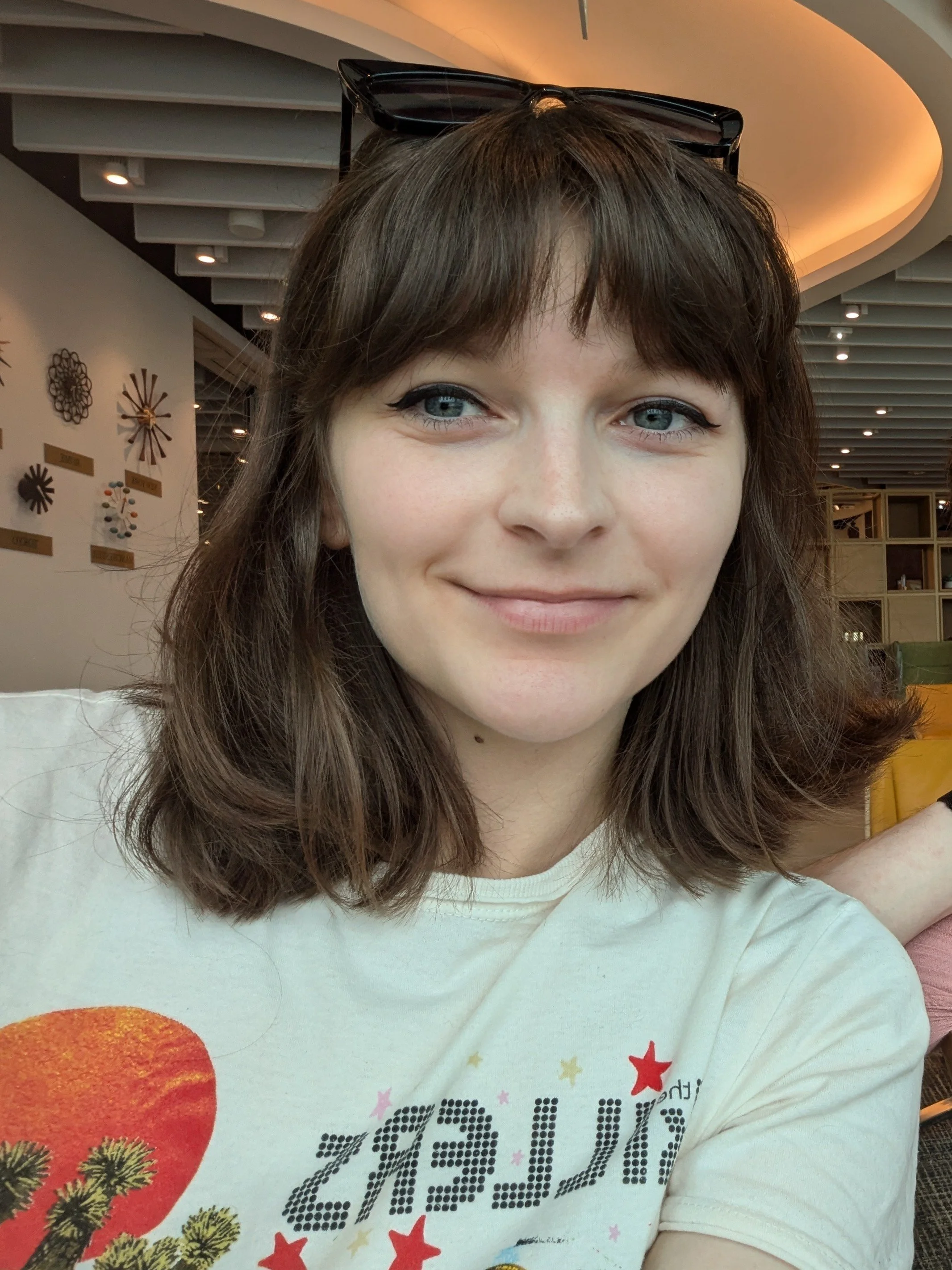
BIO: Madeleine has previously written for Litro/Crayon Magazine, Hemlock Journal and Fairlight Books, and achieved third place in a short fiction competition held by Confingo Publishing. Born and raised in Blackpool, UK, she now lives in Manchester and works in museum exhibitions.