
Your Pathways
by Renee LoBue
She ducked into the Pret A Manger at Penn Station and bought a chocolate croissant she didn’t need. Dinner with Marissa wasn’t far off — seven o’clock at Savoureux, the new French restaurant in their suburb — but she wanted something sweet to fill the waiting. The paper bag crinkled in her hand as she stepped down the stairs onto the concourse.
The crowd was thick, pressed shoulder to shoulder beneath the departure boards. Numbers flickered, trains appeared and vanished. Most people hardly looked up; their faces glowed from their phones, eyes caught in small private screens while time leaked past them.
And there they were.
At first they were only another figure in the mass — a navy T-shirt with faint lettering she couldn’t quite make out, loose navy pants, boots the color of caramel candies, a black tote swinging against one hip. Close enough that she could have brushed past them. But then they moved, ascending the same four stairs she had just come down.
The elevation was slight, but it changed everything. From that perch, leaning against the wall, they were suddenly elsewhere — luminous, untouchable.
She couldn’t quite read them. Not maleness, not femaleness, not an age she could name. They stood beyond it — both less and more than the crowd that swallowed them.
Her chest stopped. Time loosened its grip.
And then — impossibly, staring while trying not to look like staring — their head became a globe of light — transparent, radiant, alive with slow-moving brightness she alone could see.
Inside, she saw a tangle of lines — ropy, cable-like bundled cords of some unseen engine, dense and coiled, alive with potential. For an instant, their mind looked like an archive flung open: drawers half-alphabetized, folders spilling in disarray.
Filaments flared inside: sparking, veined, glowing. Some threads blazed bright with joy, longing. Others flickered dim, heavy with sorrow. And one — one was scorched. Blackened at the edges, curled like paper touched by flame.
Her fingers tightened around the croissant bag, as though it were the only solid thing left. And in a suspension that was not memory but knowing, she felt what that vision carried: a house fire, the hush before the scream, age nine. Michigan. Smoke pressing down. The frantic search for a cousin — Nathan — visiting from Colorado, also nine, who could not be found.
“Now boarding on Track Nine.”
The announcement broke the spell. She was swept forward with the others, but the vision clung to her like warmth that wouldn’t fade — the wavy hair grazing the ear, the tote bag, the charred rope she had seen inside their head now etched into her mind. She forgot all about dinner with Marissa, about Savoureux, about what day it even was.
She stepped onto the train with the others, pressed forward by the tide of boarding passengers. The car smelled of metal and damp coats — and beneath it, faintly, something older: a trace of ash, as if wood had cooled too quickly.
She shifted her gaze down the aisle — and froze.
Through the open doorway into the next car she saw them, moving slowly between rows, the black tote against their hip, about to take a seat.
Her breath caught. Before she could think, she was already moving — drawn forward through the press of bodies, threading between the seat-deciding crowd and into the next car just as they slid into the window seat. An empty space still waited beside them, but she hesitated — the closeness felt too exposed, too much.
Instead, she slipped into a seat across the aisle and one row back. It gave her a clear diagonal view — a vantage intimate enough to see without being seen.
From there she caught fragments: the navy of their shirt and pants, the edge of a boot, the sweep of hair just visible above the seat. Then their hand shifted in the light.
One large ring flashed — a raw stone set in silver, rough-edged, as if newly unearthed. From her partial view it looked like agate, its layered striations holding earth’s history inside it. The stone glimmered, then disappeared again as their hand fell back to their lap.
She leaned forward, gaze fixed, but a man dropped heavily into the seat beside her, unzipping a duffel bag and unfurling a thick hardcover novel like a shield. He began clearing his throat, a wet rasp that broke the spell in small, irritating bursts.
The train lurched into motion. Stop after stop passed, passengers funneled off, but they remained. Only her town’s stations were left now. The certainty jolted her: they were headed her way, to her town.
And still, the air carried a trace of something scorched, following like a shadow.
The scent trailed out of the station, down familiar streets, and into Savoureux, where Marissa waved from the corner table.
At Savoureux, Marissa ordered a bottle of cabernet and leaned in as soon as the bread arrived.
“I think I’m in love with my intern,” she whispered, eyes shining. “He’s twenty-three. He still eats gummy vitamins.”
She almost inhaled her water. “Marissa—”
“I know, I know.” Marissa waved it off. “It’s inappropriate. It’s reckless. It’s probably illegal in seven states. But he brings me coffee with little smiley faces in the foam. I’m weak.”
The waiter arrived with oysters. She forced a smile, pretending the faint burnt sweetness in her throat wasn’t still lodged there.
To change the subject, she confessed her own misstep: “I power-walk now. Regularly. You’d be proud. Except last month, during a Pranic Healing course in the city, I—” she lowered her voice—“made out with the instructor during the lunch break. In the bathroom.”
Marissa’s fork clattered. “Shut. Up.”
“I leaned against the sink, and my Jil Sander silk pants — my best ones — caught on a burning incense stick.” She sighed. “Ruined. Holes right across the thigh. I looked like a moth attacked me.”
Marissa slapped the table, laughing. “God, you’re a menace.”
She shrugged, tearing bread into crumbs. “Sometimes I think if I’d been married and divorced at least once, I’d be more interesting.”
Marissa shook her head. “You’re already too interesting. I’m the boring one. I’m actually considering Crocs.”
“Crocs?!”
“Yes. Lemon-yellow ones. With little fruit charms. Adorable.”
She almost spit out her water. “You swore Crocs were the downfall of civilization.”
“I lied,” Marissa said, grinning. “Civilization’s already fallen. I might as well be comfortable.”
They dissolved into laughter — sharp, sprawling, teetering between confession and collapse — absurd and intimate enough to belong only to them.
And yet, beneath it all — the oysters, the confessions only lifelong friends could share — the smell lingered, faint but insistent. A burnt sweetness threaded through perfume and garlic, louder than the clink of silverware, more present than the rise and fall of their voices.
The walk home was worse: the air thickened like pudding, every step slow, and by the time she reached her apartment she felt hungover, though she hadn’t touched a drop.
That night, as she slipped toward sleep, it was as if she’d never left Penn Station. The same suspension she’d felt in the crowd — the sudden luminosity, the impossible glow of their head — returned, unfolding again behind her eyes, drawing her deeper into corridors she hadn’t chosen but couldn’t resist.
Morning arrived like a hangover without wine. Her body felt heavy; her head, a dull hum of aftersound.
At home she downed a double espresso. On her walk to the studio, she bought another. By noon, exhausted still, she ordered a third. The bitterness barely cut through the fog. Still, her mind returned again and again to the flicker of threads veined through their inner circuitry.
At her work desk she tried to sketch new designs, but the notebook pages blurred, refusing to hold shape. A single loose agate stone sat at the edge of the table — one she had meant to set weeks ago — and it caught the light in a way that made her breath catch. She couldn’t stop thinking of their rings, the flash of layered earth against their hand on the train.
She abandoned her desk. Out on the streets she moved through errands as though half-possessed. At the new clean-beauty store she bought a coral-red lipstick for $49 — too bright, too expensive, destined to disappear into the bottom of a drawer. At the French patisserie she ordered two huge loaves of bread, enough for a dinner party she’d never host. By the time she left, the warm weight in her bag felt medicinal — a talisman against what she couldn’t name.
Weeks pressed against each other, hazed and heavy. Something in her had eased; she let it come now, the quiet current that arrived each night as natural and unchosen as sleep itself. She moved almost normally — errands, her studio, too many loaves of bread bought and half-eaten, as though padding herself against the unseen.
But fatigue threaded every day. She missed trains, nodded off on the studio floor in the middle of afternoons. Social invitations went unanswered, even from her closest friends. Paint colors she didn’t need lined her shelves in patient rows, evidence of errands she couldn’t quite remember running.
Her body moved through the hours, but her nights belonged elsewhere. Each evening, as she slipped toward sleep, she dissolved into the glowing network within them. Some cords glowed steady, others wavered, and some lay scorched, still carrying the dark heat of what they had endured.
The pull had softened, tempered, but it never vanished. What had begun as fixation had settled into ritual — a second reality twinned with daylight. Each morning she woke with the aftertaste of the hidden world she entered nightly — the nights still clinging to her, unseen and humming.
One night, lying in bed, the current rose — quiet but absolute, the same force that had gathered for weeks now cresting inside her. As if the slow shutter of her eyelids lit up a screen — a cinema only she could enter. Filaments flared, cords alive.
She saw the panic of nighttime — a Michigan house, clapboard siding, smoke spilling from the eaves, panic etched into one thread. Nathan. Searching. The cord blackened, brittle as if scorched from within.
And beneath it, another flicker: when Andrew was Emily, and the structures inside them shifting with every change of flesh, every change of mind.
She reached — not with her hand but with the current of herself — pressing light into the strand. She thought of warmth without flames, of a door opening, of safety, of Nathan stepping out alive. The cord resisted, vibrating with the echo of loss. Then, slowly, the black edges softened, color threaded through: pale blues, greens, a faint coral like the lipstick buried in her bag.
The panic dulled, not erased but released.
She gasped awake, chest aching as though she’d carried the smoke herself. She lay trembling in the dark, knowing she had crossed some invisible line. She wasn’t just watching anymore.
She was reaching for a jar of natural peanut butter when she felt it first — the tug. A shimmer of recognition before her eyes confirmed it.
They stood a few feet away, scanning jars, their hand hovering over the rows of glass like a slow blessing. The same agate rings. She froze, every glimpse from the train reassembled in an instant. Their wavy hair shifted as they tilted their head to read the label.
Her chest tightened. Without thinking, she turned her cart, wheels squeaking as she slipped down another aisle, staring blankly at boxes she didn’t need. She lingered too long, then eased toward the front, her hands guiding the cart as if through water.
And there they were again — at self-checkout. She ended up directly behind them in line, her cart the only partition holding her back. That thin divide made her body heavy with fatigue — yet simultaneously she felt as though she were hovering, light as a tissue, just above the wheels.
She watched as the machine slowly rolled out a thin slip of paper — to her, just another ticket, a fleeting glimpse of them offered and then, again, a reminder they would soon float away.
Outside, the sun was glaring. Shoppers updated neighbors on children’s college admissions in voices that tangled with the rattle of wheels across pavement. They were just ahead, loading bags into the back of an SUV. She moved faster, the cart cutting hard against the asphalt, an industrial drum announcing her approach.
The sudden surge pulled wetness onto her face. For a split second she thought it was a sun shower — or sweat broken from effort, droplets bursting in the heat. But it wasn’t rain or sweat. The tears fell strangely, almost foreign, as though they belonged to someone else and had only chosen her cheeks as their path. Not from sadness, not from joy, but from the weight of having lived inside the veined architecture of their mind — from the stark fact that she had managed to heal it.
The cart stopped just short of touching them. She stepped away from it, abandoning her groceries to thaw in the sun, and walked forward. Each step closed the impossible distance until she was right behind them, so close she could see the curve of their neck, the faint movement of breath.
They startled, sensing her, and turned. For the first time, she looked directly into their eyes. The moment froze — sunlight flashing off metal carts, the shuffle of strangers all around — all sound dulled but the rush of her own blood.
Her mouth opened before she could stop it.
“Would you like to have coffee with me—” she began, then faltered, heat rising in her face. “Or…I thought about asking you for coffee, I don’t even know what I’m saying…”
The words tangled, breaking apart. And then the only thing left, raw and unfiltered:
“Your pathways…”
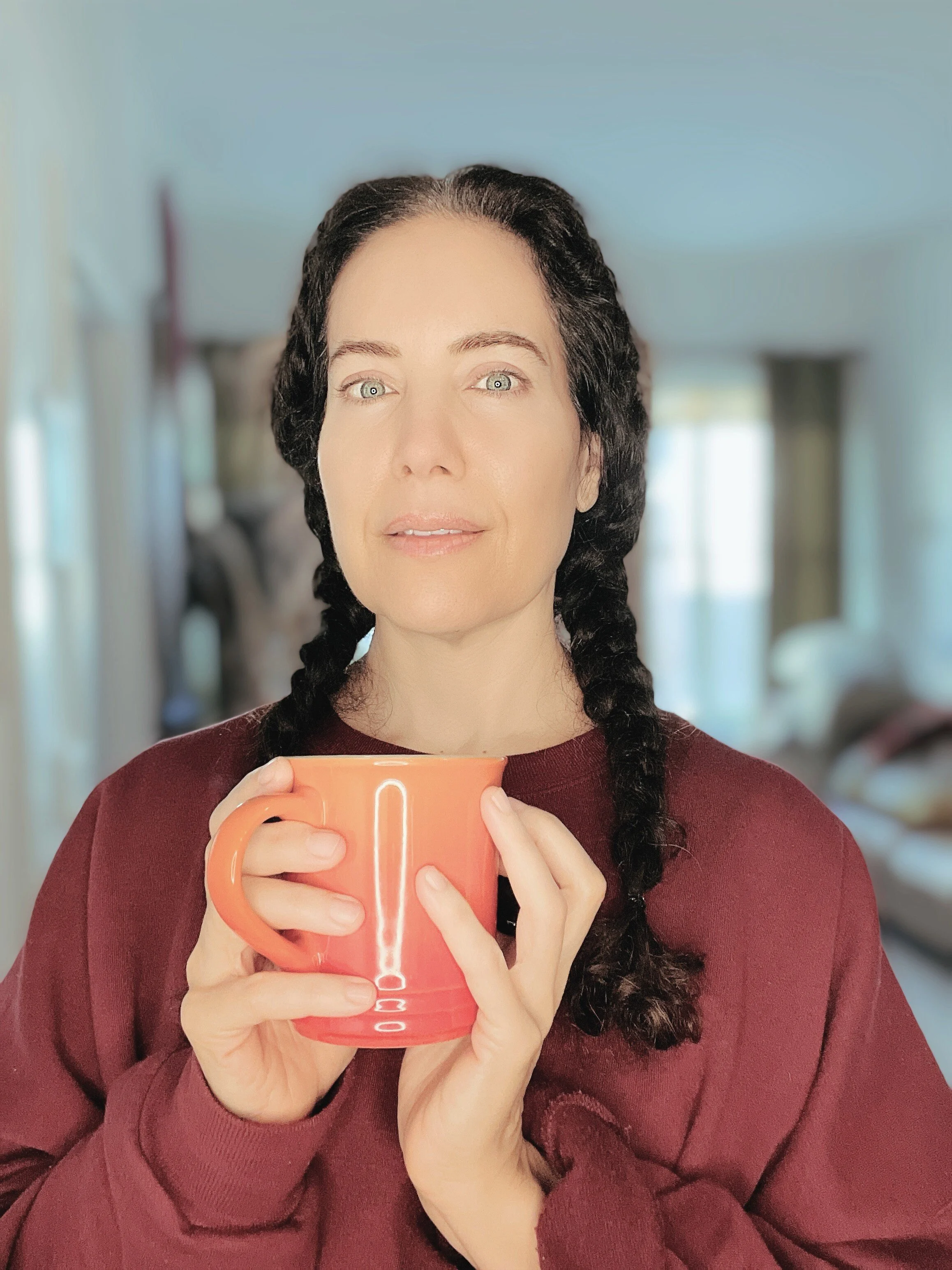
BIO: Renée LoBue is a multidisciplinary artist whose work spans music, visual art, photography, performance, and fiction. She’s released 11 albums with her bands Elk City and Flowers of America and is known for immersive audiovisual installations exploring empowerment and feminist narratives. Her short fiction adds a literary layer to her practice, weaving story into sound and image. She co-founded Magic Door Record Label and has exhibited internationally, including at Edinburgh Fringe, RoCo, and in Barcelona. LoBue is also recognized for her reinterpretation of Keith Haring’s Houston-Bowery mural in NYC. Previously Published Works: The Green Chest of Letting Go – Short Story, Published by Superpresent Magazine-June 2025 Mountainside Pool – Short Story, Published by Washington Square Review, May 2025 On Joyce – Short Story: Published by Moonstone Press in the Anthology: S/He Speaks 3: Voices of Women, Trans & Nonbinary Writers -June 2025 Additionally published by miniMAG, May 2025 In HEAVEN – Short Story, Published by Culterate Magazine, Forthcoming - Summer 2025 Clock Strikes 3 – Short Story, Published by New Words {Press}, December 2024 Leaving – Short Story, Published by Superpresent Magazine, December 2024 Snoopy Blue Eyes – Short Story, Published by The Radical Notion, a Feminist Journal, December 2024 First Cup - Audio Short Story – Official Selection – Audio Flux Podcast: “Circuit 04: Firsts” – November 2024. Socials/Web: Instagram: https://www.instagram.com/reneelobue/ Linktree: https://linktr.ee/reneelobue