
Stick and Tissue
by G.L. Bacchetta
Miniature skeletons sprawl across our kitchen table: an Italian Caproni, a Flying Tiger, a Wright Flyer, a Short Sunderland. Sinewy, steely little planes, they take surgical fingers and caring hands to come to life. First, you glue a ribcage using curved slivers of balsa wood, no bigger than toothpicks. Next, you insert a heart, the rubber band from the Sunday newspaper. Then come the wings, long and kite-like. Finally, the skin: a thin covering of tissue paper, from the fuselage to the wingtips.
You began building stick and tissue models during the Great Depression. Living on a mushroom farm in Kennett Square, Pennsylvania, you worked from sun-up to sundown, seven days of the week. The mushroom house in which you worked was two stories tall, with seven long mushroom beds stacked on top of one another. Each was made of wood and filled with compost. Inside the deep, nutrient-rich soil, tiny organisms formed hyphae: fusing, knotting, mapping, blooming. Pop taught you how to know when to harvest them. There were no lights inside the house, so you had to go by touch.
The only time you had to yourself was during your lunch break, when you would run down to the basement to build for ten minutes, or until Pop finished his lunch. “One day,” you chuckle,“ I got caught up in building a plane and did not hear him calling for me. I was so intent on building that I did not hear him come up from behind me. All of a sudden, a big, thick fist slammed down on the plane, smashing it to smithereens. BOOM! Pop never said anything, but later that night, after work and after dinner, he silently handed me a quarter. That was enough money to buy five model airplane kits."
You shared your father’s name: Vincenzo. A squat, stern, and industrious man, as bulky as an ox, Signore Vincenzo never spoke much English. Born in Abruzzo, Italy, he made the weeklong voyage to America via steamer as a young man. Once in America, he built and maintained mushroom houses, selling produce to large and small vendors alike. He extolled the utility of the mushroom. Used to treat everything from asthma to gout, to decrease the risk of cancer and to boost brain function, mushrooms carried not just culinary value but medicinal power. For thousands of years, Pop explained, humans had been growing mushrooms. It was a kind of religion, an intimate communion between humans and the earth.
A proud farmer at heart, you went on to earn a college degree in mathematics and physics, despite no one in your family holding more than a middle school education. A professional mathematician, you worked on the first ever programmable, electronic digital computer, the ENIAC: Electronic Numerical Integrator and Computer. You were fascinated by time and space, by the speeds at which information could travel. Whether beneath the soil or behind a screen, data proliferated in all directions. Beneath your fingertips stretched an expanse too vast even for the naked mind to traverse.
You learned, though, that no matter the miles or years we span, sometimes the shortest distances—the ones we think least about—are the hardest to fathom. One day, just a few miles from your house, a drunk driver swerved his tractor-trailer into your father’s pickup, crushing his ribcage. He died minutes from home. It would seem like an eternity, the length of time Pop's truck must have sat there at the edge of the road, wisps of smoke from his engine creeping into the sky.
You visited us often. Twice a month, we grandkids assembled in the windows of our ranch in suburban Atlanta, counting down the hours until your old, brown Buick rolled up on our street. It typically took you around three and a half hours to get to us. Every trip, you counted the precise number of miles on your odometer, noting the amount on a little pad of paper you carried with you. You loved numbers: their order and their consistency. You played countless games of Yahtzee with us, pausing at various junctures to have us calculate the probability of rolling a full house or a large straight.
In the front yard, you taught us golf with some of your golfing equipment. I struggled with it, and so, one time, I proposed to you a new rule: the person with the most strokes wins. This made you erupt into laughter.
You had your oddities. Up until your last moments, you only ever wore shorts, even when it was below freezing outside. I remember one day in particular, a freak snow day in Georgia. You, my brother, sister, and I walked to the local high school to sled down the massive hill behind it. We brought trash can lids and boogie boards. The entire hour or two we spent there, you stood like a sentinel in your cargo shorts and sneakers, dressed for summer, keeping watch from the top of the hill. We all laughed at you. “All that matters,” you returned, again and again, “is what’s between the ears.”
Every time you visited, you brought model airplane kits for us to build together. We assembled countless balsa gliders. You would bring your own complex creations, too, some with wingspans as wide as my outstretched arms. Whenever we happened to find, out on a walk, a tall hill or an elevated point from which to launch, we would come back the next day with a plane. Each plane got a test flight, and some were sent back to the building table after only one flight. Before lift-off, I would slowly wind up the plastic propeller. You would remind me to only coil until the rubber band began to double back on itself. Then, holding the plane as high as I could, I would launch. Some landed more gracefully than others.
I do not remember when I first learned you were sick. I remember you stumbling in the backyard once, coughing severely and struggling to catch your breath. Did you know you were sick then? Maybe the exact point did not matter to me because you seemed to be able to mend anything, from furniture to sour moods. Wasn't the body just another construction, in need of repairs from time to time? But the cancer swept like a flame through the building of your body. Silent yet swift, it spewed and spat, licking through your wooden bones. Before long, it spread to your control center, your brain.
Still, you remained steadfast, withstanding its heat, determined not to give out. Even with a permanent urostomy pouch and countless medications sprawling the bathroom sink, your body was the last thing on your mind. Wincing from the pain, you would laugh and point to your head, repeating the same mantra: “All that matters is what’s between the ears.”
It was the height of the Covid pandemic, and everyone was sheltering in place. You were at your home in South Carolina, and I was in Georgia. We had phone calls from time to time. I mostly stayed in, and you did too, as you were at a much greater risk should you contract the virus or any other illness. I trusted your cancer would pass quickly, that you would kick this sickness the way you kicked chain-smoking many years back. Dad tells me that, as a kid, he used to watch you smoke as you worked at your old walnut desk. Sometimes, you went through three or four packs in a single day. One day, Dad explains, you found yourself lighting a second cigarette when you were only halfway through the one in your hand. Frustrated, you pounded your fist on the table. BOOM! You resolved to quit, then and there, and you never lit one again.
You decided not to have surgery. The chemotherapy was exhausting, painful, and expensive, and so you wrote into your will your plan to give whatever money you had saved to your family. I remember, vividly, our last phone call. You seemed a little confused—or maybe it was me who was confused. I don't know. But I knew this would be the last time we would ever speak. Two hundred and fifty miles away, your voice cracked, pausing again and again. I did not know what to say.
On January 9th, 2021, you took flight.
It was a Saturday.
Because of the pandemic, we could not hold a funeral in person. For days, and then weeks, and then months, you sat in a small, taped-up Postal Service box marked ‘Human Remains’ on a chair in the corner of our living room. Before the box arrived, we sat in silence as Dad, holding himself together, told us that you had passed on two days prior. He had tried his very best to be there. When he received a call from a family member that you were on your last leg, he furiously drove three and a half hours to you. In your last moments, with a pen and a sliver of paper, you attempted to write something to him, but you only got past his name. When he got to you, you were already gone. He missed you by seven minutes.
After you passed, Dad gave me a stack of letters, yellow with age, that you saved from your favorite uncle, tío Luis, and his wife, tía Margarita, in Argentina. Over the course of a month, I translated them all from Spanish and Italian to English. You never got a chance to read any of them in translation, so I felt like I was writing back to you, in a way. Pop kept in constant touch with his brother in Argentina, sending long letters, and often checks, to his family. Back and forth stories traveled, over five thousand miles from Remedios de Escalada, Lanús Partido, Argentina to Chester County, Pennsylvania, USA. I like to imagine the letters sitting in the belly of an airliner, scattered among other letters, flying across the ocean.
In the longest letter, your primo Romeo discusses the death of your tío Luis. He lists all of your primos—Augusto, Aida, María, Olga—and the ways they are processing, both near and far from him. La muerte de él fue un golpe duro, he writes. Todavía la sentimos como en el primer día. Struggling to find a satisfying description, he fills four pages with ornate handwriting and flowery descriptions. But, he writes, no hay palabras. Over half a century later, his words have yet to close the wound.
Your tío Luis was a jokester. Romeo recalls one moment wherein he, your tía Margarita, and your prima Aida were teasing him. Luis erupted into a fit of laughter. All of a sudden, his body went rigid, and he fell to the ground. His heart had given out. Romeo, horrified, did not panic and began CPR. Eventually, he managed to revive him. Luis opened his eyes and chuckled. He arose. It was all pretend. Luis was the only one laughing. Perhaps a joke too far. No te podés imaginar la alegría que había en casa cuando estábamos todo. Joy and loss share the same, fragile stem. We nurse them both with the same hand.
At some point, Dad and I sat down to write your obituary. We pondered daily over it, like business partners drafting a proposal. Assembling a picture of you in writing felt impossible, so we relied on numbers. You worked as a mathematician for forty-two years. You coached baseball for thirty-three. In golf, you shot sixty-seven consecutive rounds playing your age or younger, and you shot an eighty-three in your final round at age ninety, despite being in pain from your cancer. You donated over eleven thousand hours to the local hospital. You had five grandchildren. You made it to the year twenty twenty-one. Using words was no better than using numbers. Both were too inconsistent, too porous, to hold your weight.
Given there would be no funeral, at least for the foreseeable future, writing a narrative of your life felt ceremonial, like we were bidding you farewell for good. How do you put a lifetime of feeling into a handful of words, a sequence of data? It felt like putting together a puzzle, only several of the pieces were missing. Still, the only way was through it. Grief, after all, requires assembly, even though our assemblies inevitably fail us in some way. There is no way to represent a person in writing, only to beckon toward a fading image. There is nothing the fingers can touch, nothing the brain can grasp.
I think about you often. I keep tío Luis's letters from Argentina in a neat stack atop my dresser. From time to time, I read them—not to remember you or your father, but to remember how our words always fall short, how they fell short in our final conversation. I feel motivated to write to you now because I know you cannot read this letter. No hay palabras.
This is just a test flight. Where it will land, I do not know. Somewhere, I hope, it arcs toward you.
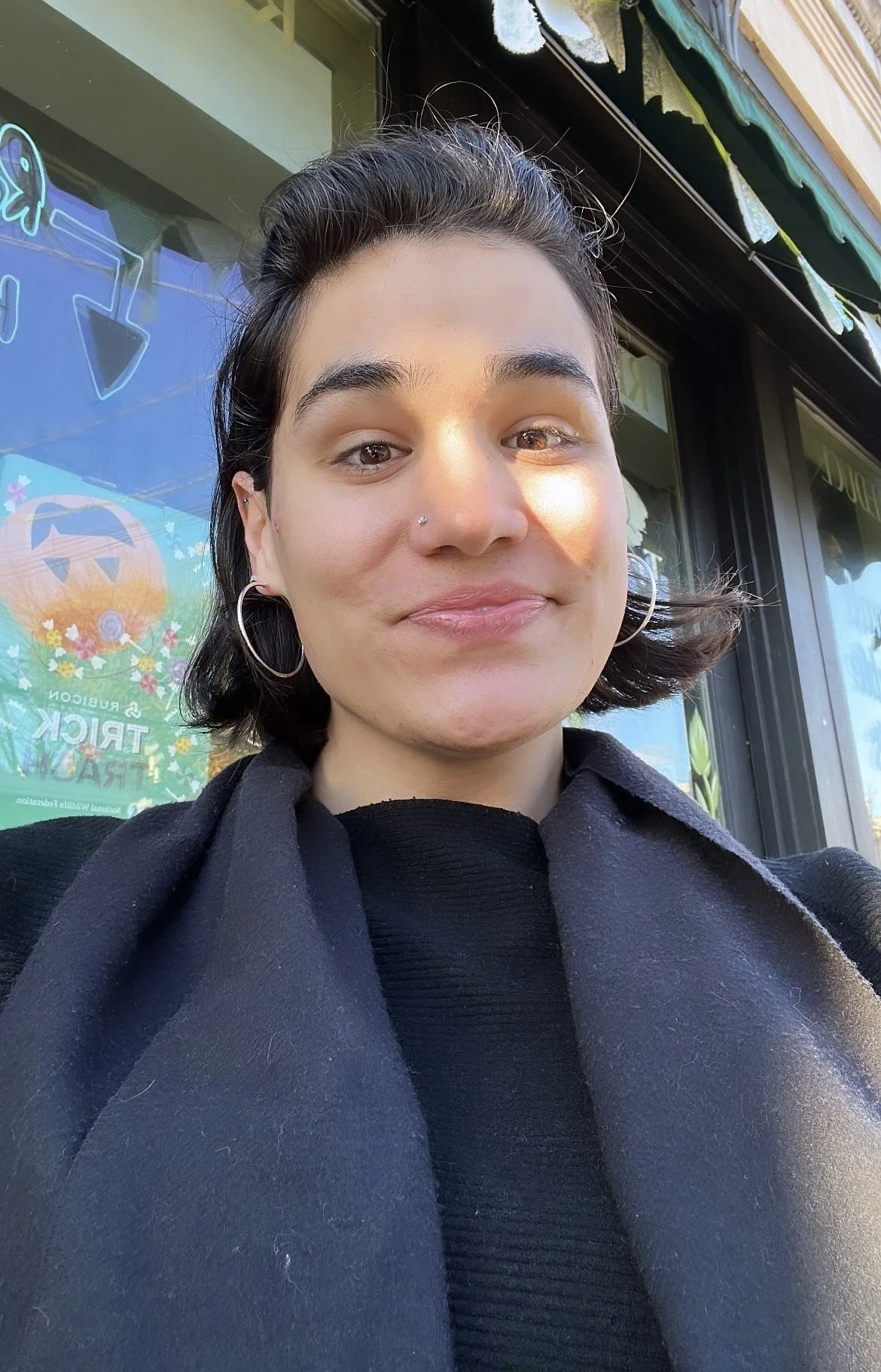
BIO: G.L. Bacchetta is a doctoral candidate in English literature whose published work spans nonfiction, fiction, and poetry in English, Spanish, and Italian. She has been nominated for a Pushcart Prize and awarded the Jacqueline and Morris Wachs Prize from Vanderbilt University. Originally from Georgia, she now calls Massachusetts home.