
Three Poems
by Sharon Hoffman
A Hay Barn in the Herbie Meadows
-- For John Chapplehow, farmer
One April years ago, we drove from Appleby
to Murton to see John's sheep, descendants
of Miss Potter's famous flock. Earlier, the ewes
had all been gathered from the high ground
and brought down for lambing, and now
they grazed in peace in newly greening fields.
Not for these sheep the usual timothy,
but ancient forage, grasses and flowers --
fescues and clovers and thistles,
buttercups and lady's mantles and yellow rattle,
grown in herbie meadows, as they say here,
and gathered and baled at the slow end of summer.
John took a picture of me posing as Bo-Peep,
complete with shepherd's crook, smiling
as I led his Herdwicks to a hay barn
older than the farmhouse by five hundred years.
To me, an American who'd been brought up
in new-built houses, this was astonishing.
The stone barn rose three stories tall,
towering skyward, with high openings
that let long shafts of sunlight fall on us
from every side, and suddenly we stood
within a cloud, golden and glowing,
and we were haloed, radiant, transfigured.
Later I learned the space around the stones
allowed in sun to keep the forage sweet,
but at the time it seemed miraculous,
a message from our oldest gods,
a bliss sent down to make us whole again.
And we were blessed by more than light.
We breathed a scent that was intoxicating,
that spring's sweet grasses, last year's flowerfields,
the clean, honeyed scent of sun-dried hay,
together in communion for long centuries --
a landscape and a way to live on earth
renewing itself endlessly through time.
And I brought away a token of that place,
a nest of hay wrapped in my handkerchief,
and I keep it here in a drawer of my desk.
Time has passed, and John lies in his grave,
but his barn endures, unchanging, and the hay
keeps its fragrance still, year after year.
Ryan Number Five
My daughter's new place has a pond so full
a hard rain pushes water high up in the yard.
There’s a pair of geese – Harold and Maude, she's named them –
who are convinced both pond and yard belong to them.
Twice a day they march themselves up on the grass,
looking for tasty things to eat. My daughter has ceded
a spot near the water’s edge to them, but manifest destiny
drives them ever closer to the tomatoes and tender herbs.
My daughter watches the disputed land and shouts out
“Oi! Oi!” when Harold advances with violence
glittering in his beady eyes.
The goose war goes on and on until one day
Maude just disappears, and Harold swims
on the far edge of the pond, a grieving widower.
Then, mirabile dictu, Maude reappears
with a little navy, a flotilla of downy goslings
in her wake. At first, we call them ducklings,
silly us, then correct ourselves.
Goslings. It becomes our favorite word.
My daughter names them Ryan One through Five,
and I confess it took me time to get the joke.
Enchanted, I sit in my wide rocking chair,
drink in hand, and stare at them half the afternoon.
as if this were the Nature Channel.
Soon I begin to worry they are not getting
enough to eat, so I shake down ripe fruit
from the mulberry trees for them.
Maude and Harold take turns standing sentinel
while the babies gorge themselves on this bounty.
Four of them behave themselves,
but Number Five is a rebel,
won't swim or walk in the right formation,
always striding ahead or dawdling behind.
She seems oblivious to threats or warnings.
While Ryan One through Four are diligently
still pecking at the ground, Five decides
to lie down on her belly in the sun and eat
only the fruit she can reach without getting up.
Oh, my darling goose girl, my mulberry queen,
C’est moi, c’est moi.
Naming the Lilies of the Field
-- For David Talbott, 1929-2008
1.
I’ve always envied Adam getting to name the animals:
the yak, the platypus, the capybara. In all honesty,
I want to name the world – all the colors
in the Crayola box, the streets in every neighborhood,
and everything that flowers in the spring.
So, I also envied David Talbott who created
hybrid daylilies (crossed and recrossed)
and christened them with passion and immense panache,
beginning of course with Solomon's Robes –
Solomon, who in all his glory, could not compete
with the flowers of the field.
2.
Thirty-some years ago, the three of us
drove down Highway 17 to Talbott’s Daylily Farm
just south of Green Cove Springs,
and in the torpor of June heat, we walked
around the beds, drinking red Kool-Aid
from Dixie cups that Mr. Talbott offered us
and reading the plant names out loud
as if we were declaiming poetry.
Naturally, I liked the names that had to do with writing:
Adjective, Articulate, Bookmark.
Lemon Lyric. Lavender Sonnet.
3.
Descriptions of the lilies were gorgeous too.
Rounded form, attractively recurved, extravagantly ruffled.
An apricot blush on the face of the flower.
Yellow halo. Striking chartreuse throat.
Lavender mid-ribs. Bold ruby heart.
You’d think from Mr. Talbott’s words,
all these flowers were beloved women.
And sometimes, in a kind of footnote:
Fertile both ways and opens early.
I’m not a botanist and can’t say precisely
what both ways means for lilies, but
it sounds like something good.
4.
While Mr. Talbott wrapped our choices up,
we wandered off into the woods
that edged the nursery. Everything smelled
intoxicating, otherworldly, the scent
of grass, soil, trees, clouds, water,
the wide river out of sight but calling us.
We felt faint, as if we might fall down
into that fragrance and drowse
on that green handkerchief of grass
and never want to rise again.
We thought that we could linger there
and rest until we became the earth itself.
There we could await the day
our next incarnation would unfold,
and then the lilies would grow up
and blossom from our bodies. One morning
we would reawaken in new forms,
brightly colored and beautifully named.
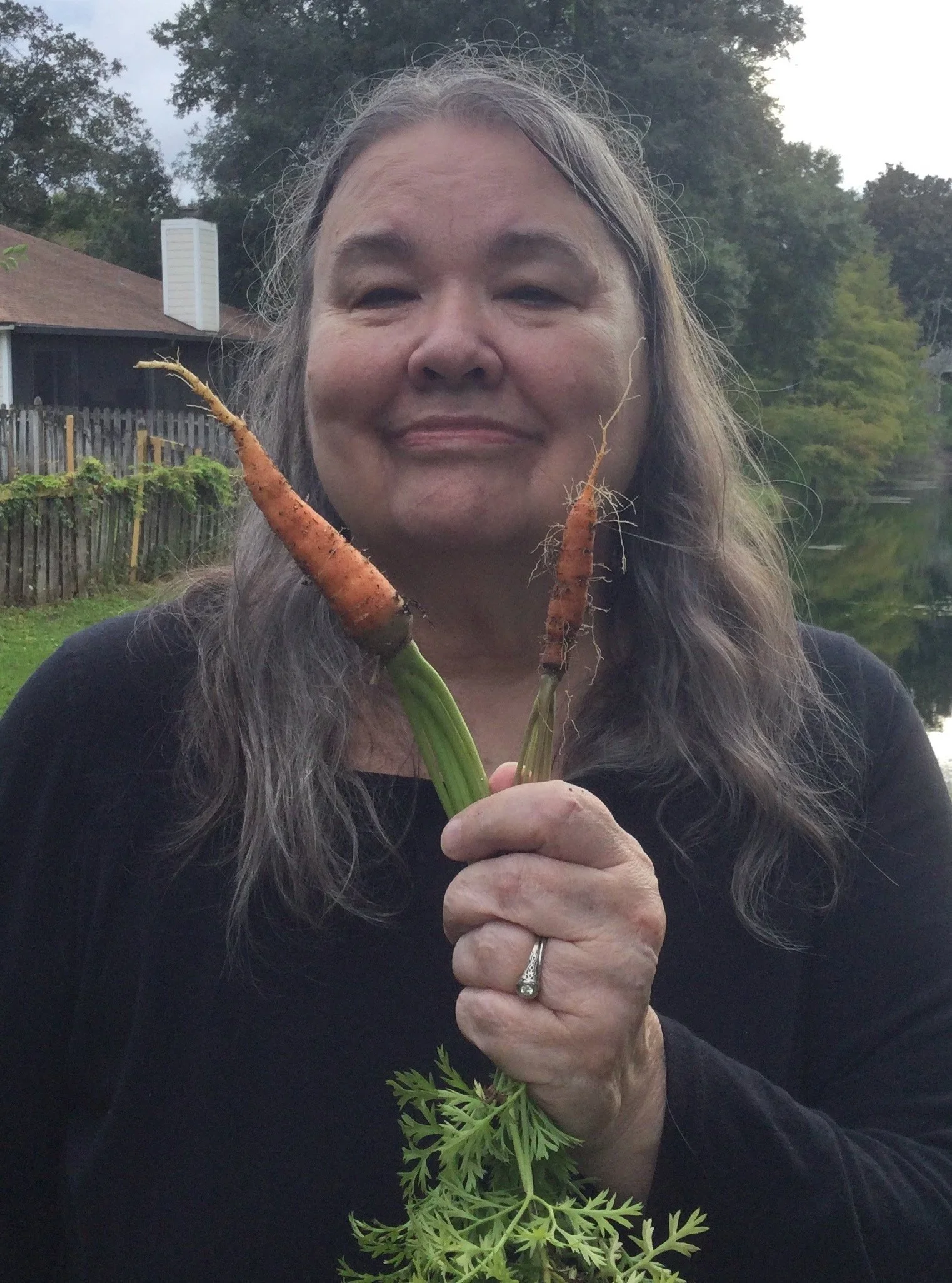
BIO: Sharon Hoffmann is a writer based in Atlantic Beach, Florida. Publications (past and forthcoming) include The Hooghly Review, New York Quarterly, Beloit Poetry Journal, Alice Walker: Critical Perspectives (Harvard University Press), Magazine1, Paddler Press, South Florida Poetry Journal, Letters, Wild Roof, Sho Poetry Journal, Blood+Honey, Burial, and other magazines. Awards include fellowships from Atlantic Center for the Arts and Florida’s Division of Cultural Affairs, three Pushcart nominations and a nomination for Best Spiritual Literature.